
Preventing Collisions Involving Blind People with “Morse Code on the Skin” OKIMO Project Wins International Award from the UK’s BMJ Selected as a Finalist for the “Global Top Improver Awards 2027”
A collision-avoidance assistance technology developed over 12 years, with specifications determined by people with visual impairments. The Akira Kimura Laboratory at Gunma Pers University will host a dialogue session at the Lisbon International Forum in April 2027.
群馬パース大学 木村朗研究室

The “OKIMO Project,” a collaborative effort between the Akira Kimura Laboratory at Gunma Perth University (Takasaki City, Gunma Prefecture) and people with visual impairments, has been selected as a finalist in the Patient & Community Engagement Award category of the “Global Top Improver Awards 2027,” organized by the UK-based medical publishing group BMJ Group.There are 15 finalists across all categories, and the BMJ announced the list on its official website on October 27, 2026 (UK time).The winners will be announced at the awards ceremony during the “Healthcare Improvement Forum” to be held in Lisbon, Portugal, on April 21, 2027, following a combination of participant voting and evaluation by a panel of expert judges. On that day, Professor Akira Kimura will attend as the team representative and will lead a table at the “World Café,” a dialogue session organized by the nominees.
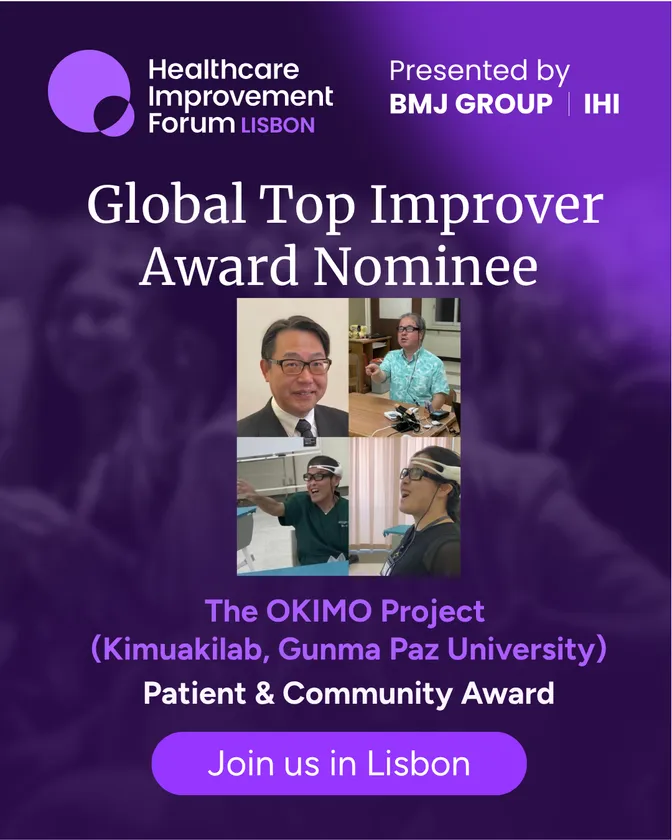
BMJ Group “Global Top Improver Awards 2027” Patient & Community Engagement Award Finalist Announcement Image (Courtesy of BMJ Group)
■ Background: Collisions Between Visually Impaired People and “People Not Looking Ahead”
Due to the increasing number of pedestrians walking while looking at their smartphones and the growing popularity of electric vehicles with quiet engines, the risk of collisions is rising as visually impaired people are unable to detect approaching pedestrians. This project began in 2014 when Kimura, a physical therapist, repeatedly witnessed collisions between pedestrians not looking ahead and visually impaired people.
■Challenge: The Limitations of Audible Warnings
For the visually impaired, hearing is the primary means of perceiving their surroundings, and audio warnings can overwhelm that sense. Furthermore, in noisy or vibrating environments—such as train station platforms—neither sound nor vibration can be reliably detected. A “third channel of information transmission” to replace hearing and vibration was needed.
■Initiative: Electrically Conductive Morse Code Signals, Specified by Users Themselves
OKIMO is a device that uses computer vision to detect the direction of an approaching person and transmits a faint electrical stimulus in the rhythm of Morse code through electrodes attached to the user’s waist. The direction of development was determined by people with visual impairments themselves, including fully blind teachers at schools for the blind.
・Warnings are conveyed “through the skin, not sound” (so as not to monopolize auditory attention)
・Prioritize “collision avoidance” over route guidance
• Conveys left, front, and right through differences in rhythm—short dots only, a mix of long and short dots, and long dots only—so that users can understand direction even without knowing Morse code
Furthermore, we are using a portable electroencephalograph (EEG) to verify how the signals are being interpreted by the brain. We have also released a version that operates using only a smartphone, without the need for specialized equipment, making it available at no cost.
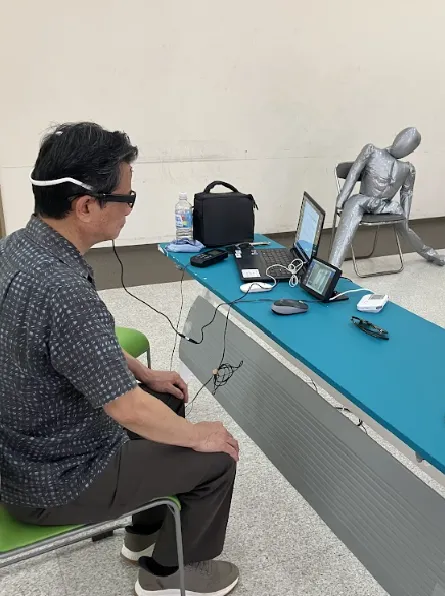
The OKIMO device transmits faint electrical stimuli in Morse code rhythms via electrodes attached to the lower back
■ Results
・In a test involving 13 blind participants, the signal transmission rate was 100% and the collision avoidance rate was 95%.
・A total of 142 participants with visual impairments have taken part since 2014
・A new EEG analysis metric, “Metric-T,” was published in the international journal *Neuroscience Informatics* (2026)
・Related patent: Patent No. 6947762. Conducted with support from the Japan Society for the Promotion of Science (JSPS) Grant-in-Aid for Scientific Research (24K06197)
■ Significance of the Selection: Visualizing “Accidents That Never Happened”
The Patient & Community Engagement Award recognizes initiatives in which patients and community members actively participate in improving medical care and support. At OKIMO, those directly affected are not merely subjects whose opinions are sought; they are the driving force behind determining the direction of the technology. Furthermore, collisions that are prevented before they occur leave no trace in records or media reports.We view this selection as international recognition of these often-invisible public health achievements.
■Activities in Lisbon
・April 21, 2027, 12:30–1:10 p.m. (local time): Kimura moderated a table at the World Café session. He engaged in dialogue with participants across approximately 15 tables over three 15-minute rounds.
・April 21, 2027, Evening: Winners in each category were announced at the awards ceremony (participant voting was conducted the week prior to the event, and winners were selected by a panel of expert judges)
・Kimura attended alone, representing the team
■ Future Developments
We plan to use EEG to verify whether the progression of learning electrical signals differs depending on the age at which vision was lost, with the goal of developing personalized training methods. Additionally, we are developing a compact, standalone device that can be used without the assistance of a caregiver, to support the safe daily mobility of people who are blind.
■ Comment from Professor Akira Kimura
“OKIMO is a technology that people with visual impairments have developed themselves—deciding on the specifications, testing them, and refining them. While the collisions we’ve prevented aren’t recorded anywhere, I’d like to share with all the participants who have collaborated with us so far the fact that this cumulative effort has been recognized on the international stage.In Lisbon, I will discuss Japan’s approach—where people with visual impairments take the lead in developing technology—with professionals worldwide who are working to improve healthcare.”

Akira Kimura, OKIMO Project Representative (Professor, Graduate School of Health Sciences, Gunma-Perth University)
■ Award Overview
Name: Global Top Improver Awards 2027
Organizer: BMJ Group (UK)
Category: Patient & Community Engagement Award
Finalists: 15 entries across all categories (announced on October 27, 2026, UK time)
Venue: Healthcare Improvement Forum Lisbon 2027
(April 20–22, 2027, CCL Lisbon Congress Center)
Awards Ceremony: April 21, 2027, evening (local time)
Official Website: https://healthcareimprovementforum.bmj.com/lisbon/improver-awards-shortlist/
Image

Logo Image

- Category:
- Corporate Trends
- Genres:
- Medical care Social welfare Technology