
CAE Software That Automates Analysis Tasks Using AI “ADVENTURECluster2026” Released
~A Solution to the “Who Will Perform the Analysis?” Problem~
Allied Engineering Corporation

Allied Engineering Corporation (SCSK Group; Head Office: Koto-ku, Tokyo, Japan; Representative Director, President and CEO: Hideki Kouguchi) has released “ADVENTURECluster2026,” the latest version of its CAE structural analysis software, on October 1, 2026.
ADVENTURECluster is Japanese-developed software that enables ultra-high-speed structural analysis of large-scale mesh models ranging from tens of millions to over 100 million nodes.Since the release of its first version in 2001, it has been adopted by more than 100 companies in Japan, including major automakers, as well as companies in the construction and agricultural machinery, heavy electrical and heavy industrial machinery, precision machinery, and electrical and electronics sectors.This version features the newly added “AI Expert,” which automates the entire process—from setting analysis conditions to executing the analysis and reviewing results—using only natural language instructions. This helps eliminate the reliance on specific individuals for analysis tasks and supports designers in making greater use of CAE themselves.Furthermore, we have implemented enhancements directly addressing challenges faced in design and manufacturing environments, including reduced computation time for topology optimization, support for designs that consider vibration characteristics, expanded applicability to large-scale models containing thin-walled geometries and warped elements, improved accuracy in contact analysis, and enhanced accuracy in deformation evaluation.
・Product Website
https://www.alde.co.jp/service/advc/index.html

ADVENTURECluster Logo
1. New Product: AI Expert
[Automation of Analysis Workflows Using AI]
● Automate everything from analysis setup to result verification using only natural language
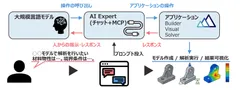
Simply by issuing instructions in natural language, you can now automate the entire process—from setting analysis conditions to executing the analysis and reviewing the results.
Traditionally, performing analyses with ADVENTURECluster required specialized knowledge and operational experience, and in many cases, verifying results required requesting assistance from an analysis specialist—which posed a challenge to the broader adoption of CAE.
This version features the new “AI Expert” product. For example, a designer can simply ask, “Where is the maximum stress?” to quickly review the analysis results. This allows even non-experts to easily access the information they need, significantly broadening the scope of CAE utilization.
Furthermore, for analysis specialists, the AI assists in setting analysis conditions by identifying differences from similar past models, thereby reducing the burden of repetitive configuration tasks. This creates an environment where specialists can focus on more advanced analyses and problem-solving.
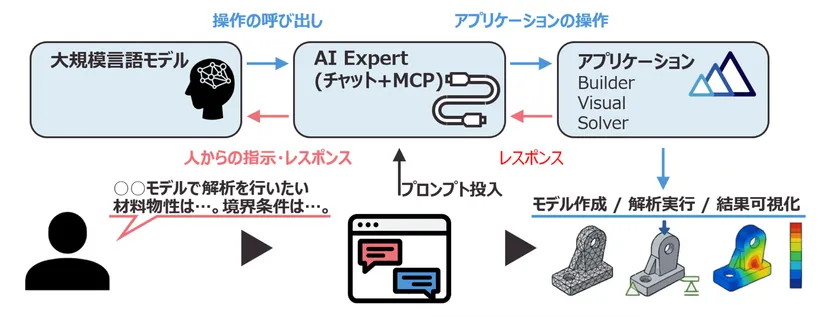
AI Expert
2. New Features
[Enhanced Analysis Preparation and Execution]
● Reduced calculation time for topology optimization and added support for designs that consider vibration characteristics
In addition to reducing the computation time for topology optimization, the software now supports the handling of vibration characteristics (natural frequencies).
Topology optimization involving die-cutting constraints is highly nonlinear and difficult to converge, which previously made computations time-consuming. As a result of improvements to the calculation algorithm, computation time has been reduced by several tens of percent; for some models, reductions of up to approximately 15% of the previous time have been confirmed. Design studies utilizing topology optimization can now be conducted in a shorter timeframe than before.
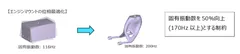
Regarding vibration characteristics, in previous versions, it was necessary to evaluate the optimized shape using vibration analysis after it was obtained and revise the design as needed. With the new capability to set natural frequencies as evaluation functions or constraints, it is now possible to derive shapes that balance weight reduction and vibration performance right from the optimization stage.For example, by setting a condition to improve the natural frequency by 50% compared to the initial geometry and performing optimization, it is possible to derive a geometry that meets the target vibration characteristics. In the development of components where vibration characteristics are critical—such as engine and transmission mount designs—design studies that balance weight reduction and vibration performance can be conducted efficiently.
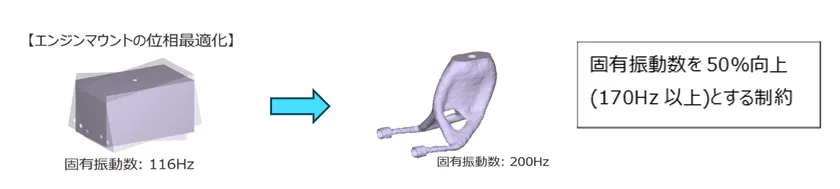
Topology Optimization
● Enhanced support for models containing thin-walled geometries and distorted elements — AMG method support
The scope of analysis for large-scale models containing thin-walled geometries and warped elements has been expanded.
Previously, calculations for such models tended not to converge easily, and depending on the analysis conditions, it was sometimes difficult to obtain sufficient results.
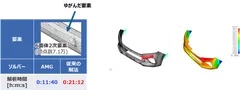
Support for the AMG (Algebraic Multigrid) method has expanded the range of cases in which the analysis can be applied to models that were previously difficult to converge.This broadens the scope of analysis for models containing thin-walled geometries and warped elements, aiding evaluation and review during the design phase. In addition to its expected applicability to problems that are difficult to converge, the AMG method allows analyses to be performed with relatively low memory usage, making it a foundational technology that supports the application of analysis to a wider range of models.
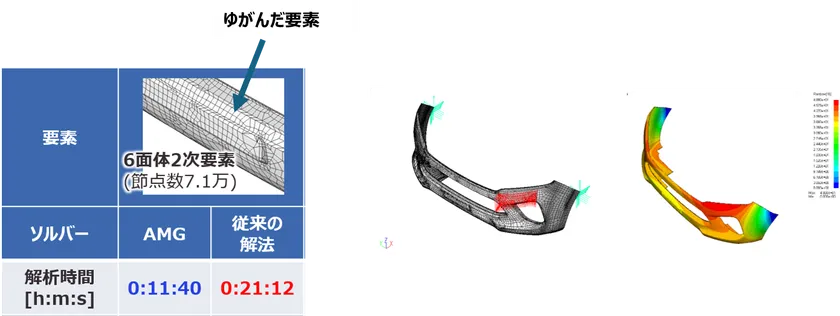
AMG Method Support
[Improved Evaluation Accuracy]
● Achieves higher accuracy in contact analysis, such as bolt loosening prediction — Equipped with a new friction model
It is now possible to evaluate the complex behavior occurring at contact points with greater accuracy.
At contact points in products and machinery, repetitive loads and vibrations can cause microscopic slippage, and the accumulation of this slippage can lead to performance degradation or malfunctions. However, it has been difficult to adequately reproduce these phenomena in previous analyses.
One example of its application is the prediction of bolt loosening behavior caused by cyclic loading. It is expected to be utilized in various analyses where contact and friction are critical, including the evaluation of fasteners in automotive parts and industrial machinery.
This capability is made possible by the newly incorporated “Hashiguchi Friction Model.” Because it can reproduce the accumulation behavior of microscopic slippage occurring at contact surfaces, it enables contact analysis with higher accuracy than before.
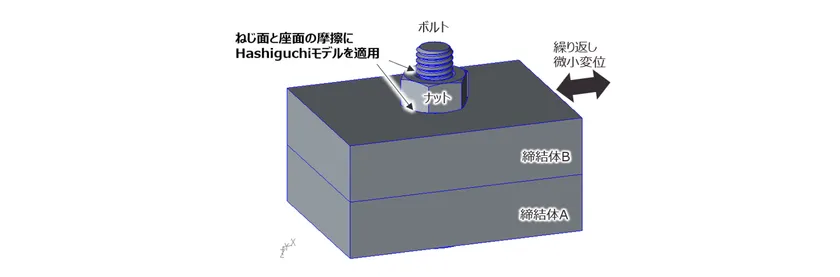
New Friction Model
● Visualizes only the “true causes” of deformation to improve evaluation accuracy — Alignment Function
It is now possible to more accurately evaluate “warping” and “distortion” that affect product quality.
When evaluating part deformation, the results often included not only the geometric changes of interest but also the overall translation and rotation of the part, making it difficult to determine exactly where and to what extent deformation occurred.
With the newly added alignment function, the pre- and post-deformation geometries are automatically superimposed, allowing users to visualize only the geometric changes they truly wish to evaluate. This enables a more accurate understanding of the causes of deformation in applications such as part warpage evaluation, shrinkage correction, and jig accuracy assessment.
This functionality is achieved by aligning the post-deformation shape with the pre-deformation shape, thereby eliminating the effects of overall part displacement and rotation and displaying only the pure shape changes.

Alignment Function
3. Future Outlook
With the advancement of AI, we are entering an era in which manufacturing sites, engineering methodologies, and the very nature of CAE are set to undergo significant changes.Amid these changes, we will continue to evolve to pioneer the future of CAE and AI, and we will work alongside our customers to pursue the ideal form of next-generation CAE. We are particularly focused on new applications of CAE—beyond mere automation and labor savings—through AI agents and platform integration.In workplaces facing a growing shortage of personnel—including dedicated analysis specialists—“AI Expert” serves as a key component in building AI agents, helping to address this shortage. Going forward, we will work to develop idea-generation support functions utilizing shape-generation AI, as well as enhance computational performance, analysis technology, and usability, thereby supporting our customers in accelerating development speed, improving quality, and strengthening their competitiveness.
[About Allied Engineering Corporation]
Since its founding in 1981, Allied Engineering Corporation has been guided by the principles of “pursuing technological innovation,” “contributing to our customers,” and “contributing to society.” With its advanced technical capabilities, the company meets the needs of the industrial sector and contributes to technological innovation and societal development.
・Address: 13th Floor, Toyosu Foresia, 3-2-24 Toyosu, Koto-ku, Tokyo
・Business Activities: Development, contract analysis, and sales of the CAE system ADVENTURECluster;
Development and sales of parts configuration systems, contract development, and consulting
・Company URL: https://www.alde.co.jp/en/index.html
*All product names, company names, and service names listed herein are trademarks or registered trademarks of their respective companies.
Image



Logo Image

- Category:
- Services