
Detecting Changes in the Kidneys—the “Silent Organ”—Through Cat Urine New Research Presented at the Japanese Society of Veterinary Nephrology and Urology!
~Results of the Second "JIN-nyan Sign" Test and the Latest Research on "Inutouki" Released Simultaneously; Over 350 Visitors~
林技研株式会社

The “JIN Katsu Research Institute,” operated by Hayashi Giken Co., Ltd. (Headquarters: Shinjuku Ward, Tokyo; Representative Director: Motohiro Hayashi), exhibited at the “18th Annual Scientific Meeting and General Assembly of the Japanese Society of Veterinary Nephrology and Urology,” held from Saturday, August 22, to Sunday, August 23, 2026.
At the booth, the company unveiled for the first time the results of the second round of testing for “JIN Nyan Sign,” a health check sheet designed to encourage visits to veterinary clinics by highlighting physical and chemical changes in a cat’s urine. It also exhibited and presented the latest academic research data on the traditional Japanese and Chinese medicinal plant “Inutoki,” as well as new products currently under development.
Despite the limited viewing time during the conference breaks, our booth was flooded with veterinarians and researchers, generating such a tremendous response that we nearly ran out of the 350 sets of research materials and samples we had prepared.
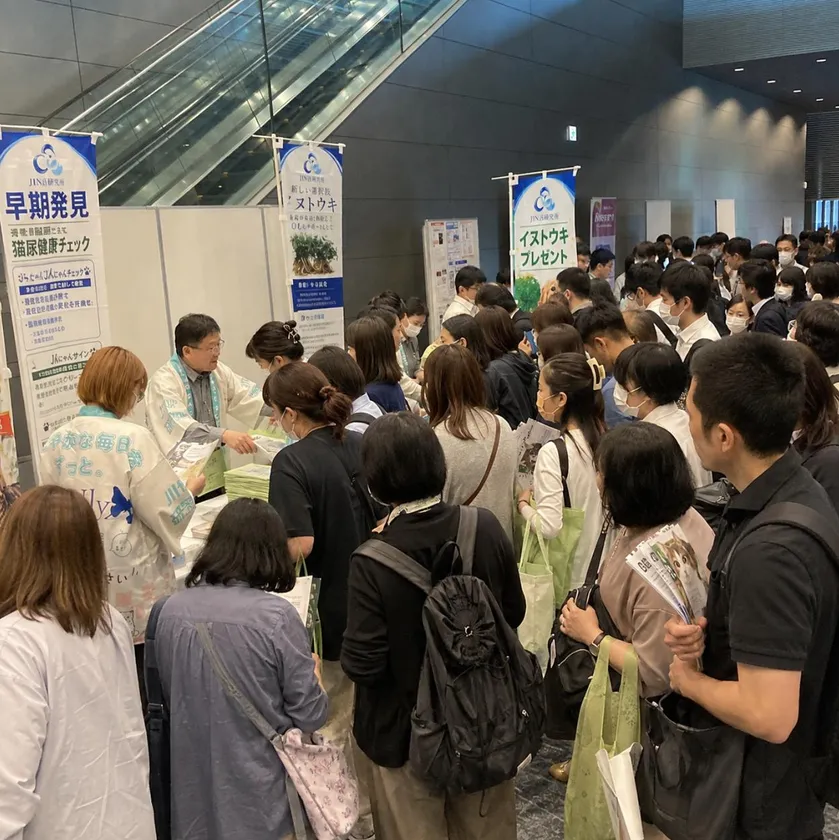
Exhibition at the Japanese Society of Veterinary Nephrology and Urology Booth
■ Background: “Chronic Kidney Disease”—a Cat’s Inevitable Fate—and the Barriers to Early Diagnosis and Care
Chronic kidney disease (CKD), one of the leading causes of death in cats, is a common condition said to affect more than one in three senior cats.
The kidneys are often referred to as the “silent organ,” and in many cases, by the time visible symptoms such as excessive thirst and urination or loss of appetite appear, the cat has already lost most of its kidney function.
Since it is extremely difficult to restore lost kidney function, there is a strong need for a two-pronged approach: “promptly seeking veterinary care based on subtle changes in daily behavior (early detection)” and “maintaining kidney health from the pre-disease stage (early care).”
At the JIN Katsu Research Institute, we are promoting the research and development of a “pre-disease care system” designed to consistently address these two challenges.
■ Main Presentations at the Conference
1. [Early Detection] Public Release of the Second Test of “JIN Nyan Sign,” Which Encourages Veterinary Visits Based on Urine Behavior
We presented empirical data on “JIN Nyan Sign,” a health check sheet designed to help owners notice subtle changes in their cats’ daily urine patterns and encourage them to consult a veterinary clinic.
In developing this tool, we have welcomed a researcher who received the Best Paper Award from the Japanese Society of Pet Nutrition to our joint development team and are proceeding with technical design based on scientific evidence (*patent pending).
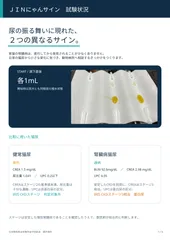
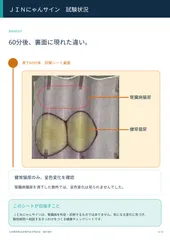
In this exhibition, we released comparative test data using urine from healthy cats and cats with kidney disease (equivalent to IRIS Stage 3, with proteinuria). We presented photographic evidence demonstrating clear differences in water absorption behavior immediately after application, as well as distinct differences in the characteristic color changes on the back of the sheet after 60 minutes.
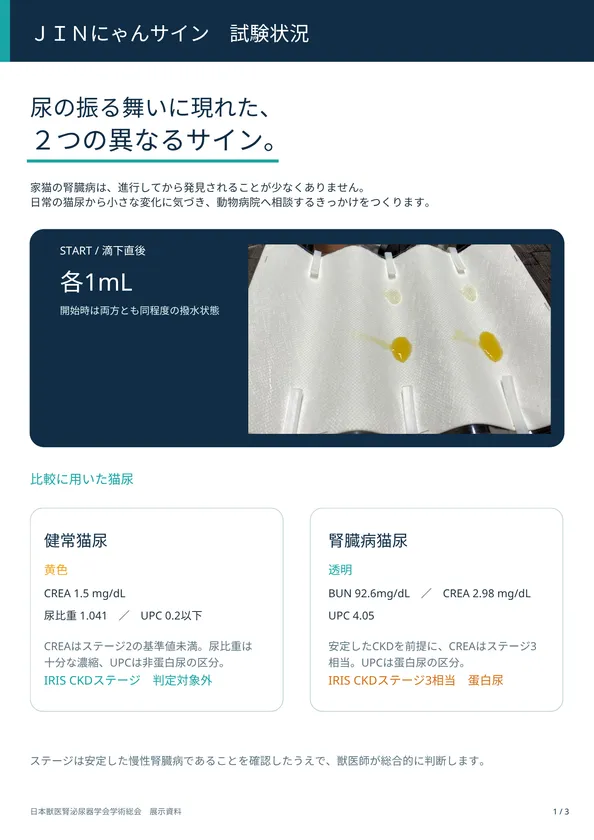
Figure: Initial conditions of the “JIN Nyan Sign” application test and clinical indicators of the cat urine samples used for comparison (healthy cat urine vs. cat urine from a cat with kidney disease)
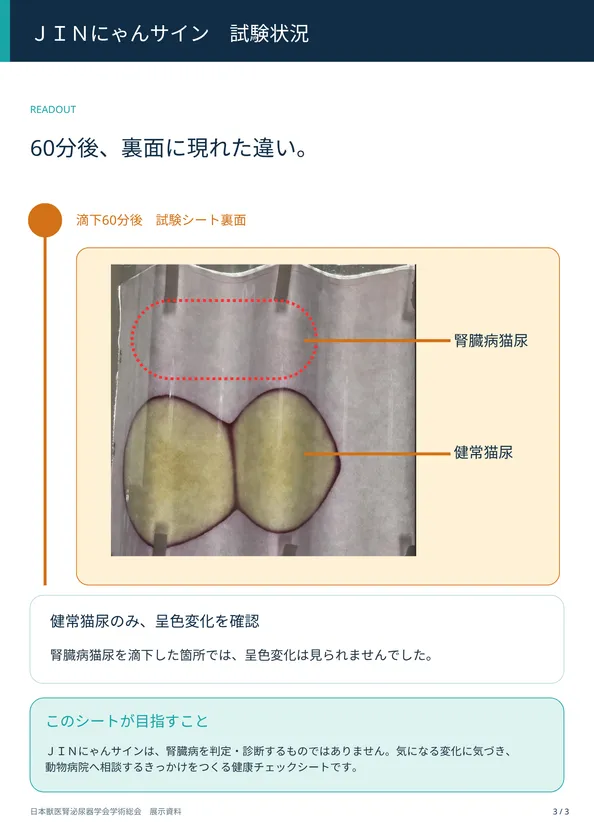
Figure: Comparison of color changes on the back of the test strip 60 minutes after applying “JIN Nyan Sign” (color change confirmed only with healthy cat urine)
*“JIN Nyan Sign” is not intended to diagnose or determine the presence of kidney disease; rather, it is a health check tool designed to help pet owners quickly notice abnormalities in their cats and serve as a bridge to seeking veterinary care.
2. [Early Care] Release of Academic Data on the Traditional Japanese and Chinese Herb “Inutoki” & Announcement of a New “Tablet-Type” Formulation to Overcome Bitterness
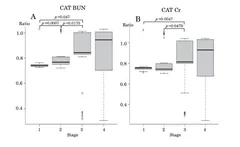
This clinical data, derived from academic research on the traditional Japanese and Chinese medicinal plant “Inutoki,” verifies trends and statistically significant differences (p-values) in key renal function markers—BUN (blood urea nitrogen) and Cr (creatinine)—across the various stages of chronic kidney disease (CKD) in cats.
The data demonstrate changes in biological indicators as the disease progresses and the efficacy of Inutoki supplementation. At the conference booth, this evidence-based approach to pre-disease and kidney care garnered significant interest from many veterinarians and specialized researchers.
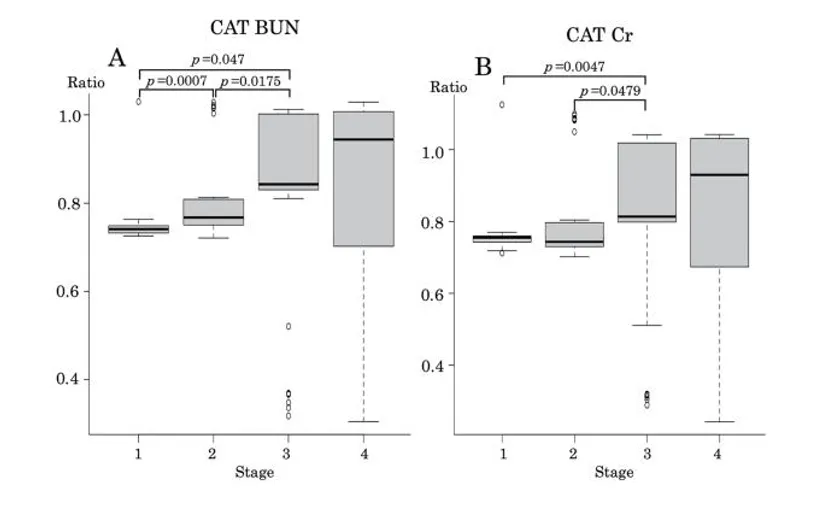
Figure: Data on trends in BUN (blood urea nitrogen) and Cr (creatinine) ratios by stage of chronic kidney disease in cats, along with statistical significance analysis (excerpted from academic research presentation materials)
In addition, we unveiled for the first time the “JIN Power 100 Tablet Type,” currently under development to overcome the characteristic bitterness of Angelica acutiloba and make daily administration easier, alongside the 100% Japanese herbal supplement “JIN Power 100 (Powder),” which is currently attracting attention from cat owners.
■ Response at the Conference and Future Outlook
Despite the tight schedule during the conference, more than 350 veterinarians, veterinary nurses, and specialized researchers—representing approximately 80% of the estimated 450 attendees (excluding staff)—visited our booth.
We observed attendees asking enthusiastic questions, and our “approach to prompting veterinary visits using urine samples collected at home” and “the potential of evidence-based Japanese and Chinese herbal care” received extremely high praise and generated significant anticipation from the clinical community.
Based on the insights and feedback received from experts at this event, the JIN Research Institute will accelerate further research and development, aiming to establish a “preventive care ecosystem” where all dogs and cats can live healthy lives.
Furthermore, we plan to gradually unveil the research findings and product lines presented at this conference through events for pet owners and media outlets this fall.
■ Institute Overview
Institute Name: JIN-Katsu Research Institute (Operating Company: Hayashi Giken Co., Ltd.)
Representative: Motohiro Hayashi, Representative Director
Address: Room 606, Meiji-dori Building, 2-3-21 Kabukicho, Shinjuku-ku, Tokyo 160-0021
Business Activities: Research, development, and sales of preventive care products and healthcare tools for pets
Official Website: https://lit.link/inutouki
Image

Logo Image

- Category:
- Corporate Trends
- Genres:
- Pets - Dogs Pets - Cats Medical care