
WEF Technology Development Aims to Realize a Circular Process for Machining and Cleaning New Possibilities Confirmed Through AOS Technology
Promising Results from W-Gaia's Basic Tests on Oil Removal and Washwater Reuse
WEF技術開発株式会社

WEF Technology Development Co., Ltd. (Headquarters: Otsu City, Shiga Prefecture; President: Akira Aoyama) conducted preliminary tests using its proprietary AOS (Advanced Oxidation System) technology to remove cutting oil adhering to workpieces after metal cutting, and confirmed significant potential.
In the metalworking industry, large quantities of cleaning agents are used to remove cutting oil and machining oil adhering to workpiece surfaces after machining. As these cleaning solutions are reused, they become waste liquid containing oil and metal particles, which is often disposed of as industrial waste.Consequently, companies face a significant financial burden not only from the cost of purchasing cleaning agents but also from waste liquid treatment and management costs. Furthermore, as global efforts to realize a circular economy and achieve the SDGs advance, reducing the use of cleaning agents and minimizing the generation of waste liquid have become critical challenges shared by the manufacturing industry.
To address this challenge, WEF Technology Development Co., Ltd. conducted basic validation of the potential for a new cleaning process using the “W-Gaia” device, which utilizes AOS (Active Oxygen Oxidation and Decomposition).
・OH (hydroxyl radical) instantly breaks down the C-C bonds in oils. However, because ・OH disappears instantly, it has traditionally been considered difficult to control or utilize industrially.In this study, WEF used patented technology to generate large amounts of ·O₂ (superoxide) from atmospheric oxygen, mixed it with O₃ (ozone) to produce ozonide ions (ionized ozone), and then introduced these into microbubbles (MBs) to bring them into contact with workpieces submerged in water.When the bubbles burst underwater and come into contact with water, the ozonide ions immediately become ·OH.

Image (2) OH Radical Generation
[Cleaning Test]
In this test, ozonide ions were aerated into 20 L of hot water at 50°C using an aeration tube. Fifteen workpieces (machined tubes) were placed in a mesh basket and moved up and down in the water for 15 minutes.
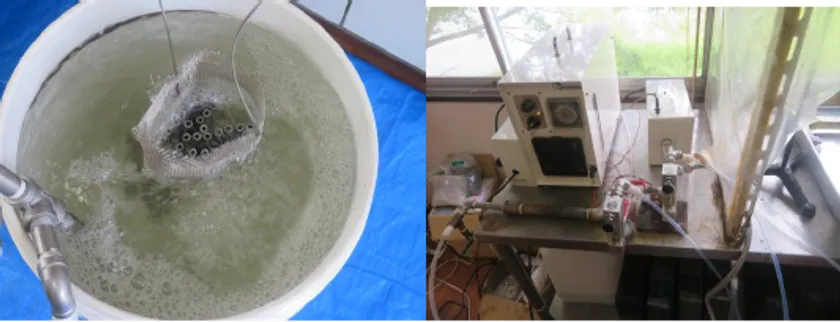
Image (1) / (Left) Cleaning process, (Right) AOS generation test apparatus
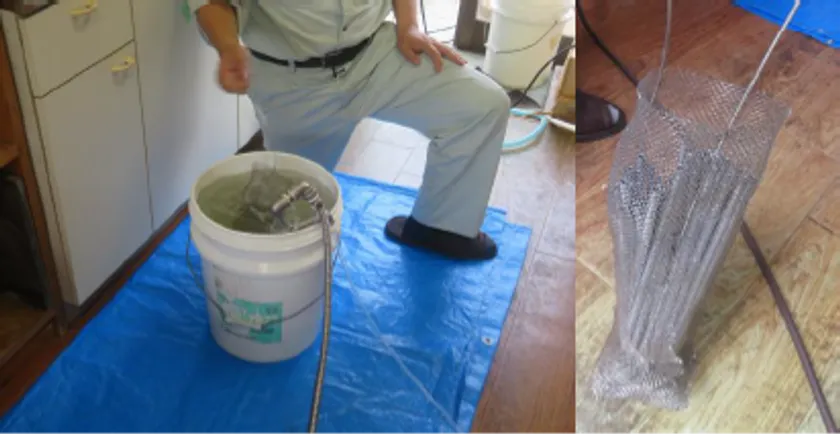
Image (3) Cleaning in Progress & Workpieces Being Cleaned
[Cleaning Results]
1) Cleaning Verification Method
Oil residues on the inner and outer surfaces of the workpieces were extracted with methanol, and the extract was analyzed using a gas chromatograph-mass spectrometer (GC/MS).
2) We also analyzed the oil concentration in the water after workpiece cleaning. Additionally, we subjected the post-treatment cleaning water to AOS treatment for 24 hours to verify whether the cleaning water could be reused.

Image (4) Cleaning Results
【Discussion】
In the tests conducted here, we confirmed that cleaning oil-contaminated metal workpieces using AOS bubbles significantly removed oil from the workpiece surfaces. Furthermore, we found that the oil content transferred from the workpieces to the cleaning solution was significantly reduced through 24 hours of AOS treatment.
This test confirmed that AOS technology
・the ability to strip oil from metal workpieces
・The ability to oxidize and reduce oil that has migrated into the cleaning solution
.
Moving forward,
・Improving cleaning performance through combined use with ultrasound
・Long-term recycling of the cleaning solution
・Reducing detergent usage
・Reducing the volume of waste liquid generated and industrial waste
・Evaluation of the effects on metal materials (corrosion resistance and surface properties)
We are conducting demonstration tests on these aspects with the goal of commercializing this technology as a new, environmentally friendly metal cleaning method.
WEF Technology Development Co., Ltd. is conducting joint demonstration projects with companies in the fields of machining, parts cleaning, automotive parts, aircraft parts, precision machinery, and semiconductors, with the goal of contributing to the reduction of chemical use, the promotion of recycling, and decarbonization in cleaning processes.
■Company Overview
Company Name: WEF Technology Development Co., Ltd.
Representative: Akira Aoyama, Representative Director
Address: 1-19-15 Do, Otsu City, Shiga Prefecture
Established: July 2016
Business Activities: Water treatment, waste recycling, development and sales of magnesium-related technologies
https://mgworld.aoyama-wefit.com (Magnesium World)
Image


Logo Image

- Category:
- Corporate Trends
- Genres:
- Technology Economy(Japan) General Business