
First Demonstration of 100-Gbps Class Wireless Communications Above 420 GHz ~Ultra-fast mobile backhaul technology for Photonic 6G
徳島大学ポストLEDフォトニクス研究所

A research group led by Lecturer Yu Tokizane, Associate Professor Hiroki Kishikawa, Professor Naoya Kuze, and Professor Takeshi Yasui of Tokushima University's Institute of Post-LED Photonics / Photonics Health Frontier Research Institute, Graduate Student Takumi Kikuhara of the Graduate School of Frontier Sciences, Tokushima University, and Visiting Professor Tadao Nagatsuma of the Institute of Post-LED Photonics, Tokushima University, and Professor Shintaro Hisatake Prof. Shintaro Hisatake's research group has developed a micro-optical comb-driven terahertz communication system to realize stable and high-speed wireless communication.
<Points>
Conventional electronic technology has difficulty in generating high-frequency signals above 350 GHz, and a new method was required to realize ultrahigh-speed wireless communications for 6G.
The terahertz transmission using a fiber-optic micro-optic comb demonstrated a single-channel 112 Gbps wireless transmission in the 560 GHz band.
This achievement is expected to establish a technological foundation for the realization of ultrahigh-speed mobile backhaul communications and converged optical/wireless networks in 6G.
<Report Summary>
Mobile communications have been improving their speed and capacity by increasing the frequency of wireless carrier frequencies, and the next generation of mobile communications (6G)(Note 1), which is expected to begin service in the 2030s, is expected to use terahertz waves above 300 GHz, but in the region above 350 GHz, the limitations of signal generation using conventional electronic However, in the region above 350 GHz, it has been difficult to realize stable and high-speed wireless communications due to the limitations of signal generation using conventional electronic technology and the increase in phase noise.
A research group led by Lecturer Yu Tokizane, Associate Professor Hiroki Kishikawa, Professor Naoya Kuze, and Professor Takeshi Yasui of Tokushima University's Institute of Post-LED Photonics / Photonics Health Frontier Research Institute, Graduate Student Takumi Kikuhara of the Graduate School of Frontier Sciences, Tokushima University, and Visiting Professor Tadao Nagatsuma of the Institute of Post-LED Photonics, Tokushima University, and Professor Shintaro Hisatake of the Faculty of Engineering, Gifu University, has been working on the realization of stable and high-speed wireless communications in these regions. Professor Shintaro Hisatake's research group has developed a micro-optical comb-driven terahertz communication system that combines terahertz wave generation using an optical fiber-coupled micro-optical comb (Note 2) and multi-level modulation technology to solve these problems (Figure 1). In this research, low phase noise terahertz carriers were generated by utilizing the highly stable frequency characteristics of the micro-optical comb, and single-channel 112 Gbps wireless transmission in the 560 GHz band was demonstrated. This achieved a higher speed than the conventional several tens of Gbps class.
This achievement is the first demonstration of the feasibility of 100 Gbps-class wireless communications in the region above 420 GHz, and is expected to serve as an important technological foundation for the realization of ultrahigh-speed backhaul communications and optical-wireless convergence networks in 6G.
For more information, please click here.
Yasui Laboratory, Post-LED Photonics Institute, Tokushima University
Explanatory video by YouTube channel
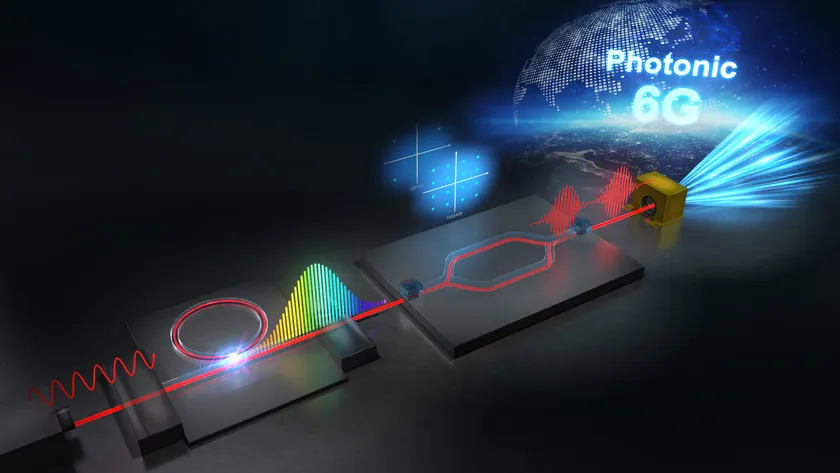
Figure1: Conceptual diagram of micro-optical comb-driven terahertz communication
<Background and History of Research>
Mobile communications have achieved higher speed and capacity by increasing the radio carrier frequency. Millimeter wave bands have been used for 5th generation (5G) communications, but in order to meet the further increase in demand for future communications, terahertz waves above 300 GHz are expected to be used in the next generation of mobile communications (6G), which is expected to be commercialized in the 2030's. In particular, terahertz waves in the region above 350 GHz are expected to be used in the future. In particular, while ultra-high-speed communications utilizing a wide bandwidth are possible in the region above 350 GHz, there are limits to high-frequency signal generation using conventional electronic technology, and issues such as reduced output power and increased phase noise have become apparent. Therefore, there has been a need to establish a new technology that can generate stable and high-quality signals.
Against this background, this research group has focused on optical technology as an alternative to electronic technology, and has conducted research on terahertz signal generation using micro-optical comb, a type of optical frequency comb, and its application to wireless communications, namely, micro-optical comb-driven terahertz communications (Photonic 6G(*3)). Photonic 6G(*3)). Micro-optical comb is a promising technology for generating high-quality wireless carriers in the terahertz band due to its high frequency stability, low phase noise characteristics, and wide frequency spacing. However, in the region above 350 GHz, it is difficult to achieve both stable high-frequency signal generation and high-speed data transmission by high-order modulation, and practical wireless communications have not yet been realized.
Against this background, this research aims to solve the technical problems to realize ultrahigh-speed wireless communications in the region above 350 GHz and to demonstrate 100 Gbps-class communications.
<Research Activities and Results>
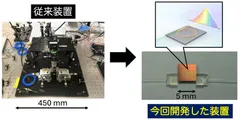
In this study, we first developed a micro-optical comb device using an optical fiber-coupled micro-optical resonator to realize a stable and compact terahertz signal source. By directly connecting an optical fiber to a micro optical resonator made of silicon nitride using optical adhesives, we have eliminated the need for optical microscope observation and precise optical adjustment using a multi-axis stage, which were conventionally required, and achieved a significant miniaturization of the device (Figure 2). Furthermore, this configuration significantly improves the time stability of the excitation light coupling efficiency, enabling the use of high power excitation light. As a result, stable operation over a long period of time is possible, establishing a fundamental technology for highly stable and low-noise signal generation in the terahertz band.
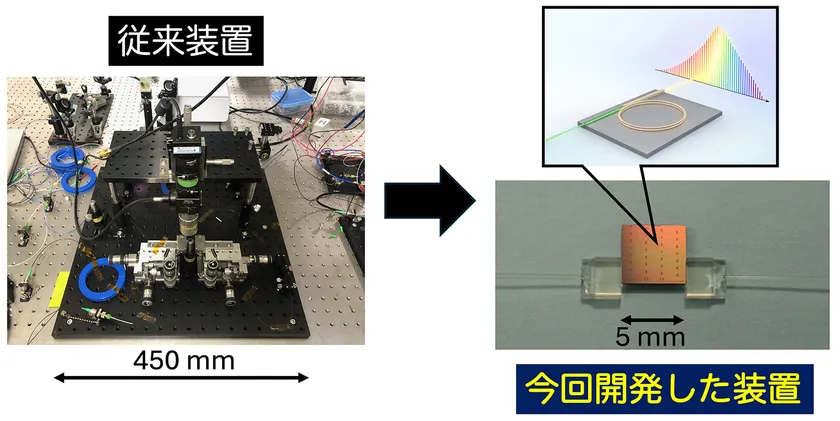
Figure2: Micro-optical comb device using an optical fiber-coupled micro optical resonator
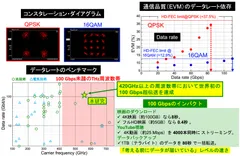
Next, we constructed a terahertz wireless communication system using this fiber-coupled micro-optic comb. Two-wavelength optical carriers with high stability and high signal-to-noise ratio were generated by optical injection synchronization of the micro-optic comb, and multi-level modulation (QPSK and 16QAM) was applied in the optical domain. Then, a 560 GHz multi-level modulated terahertz wave was generated by photomixing, and the modulated signal was carried wirelessly. At the receiver side, the signal was demodulated by heterodyne detection using a subharmonic mixer. As a result, 84 Gbps in QPSK modulation and 112 Gbps in 16QAM modulation were achieved in wireless transmission (Figure 3). This is the first demonstration of 100 Gbps-class wireless communication in the unexplored frequency band above 420 GHz.
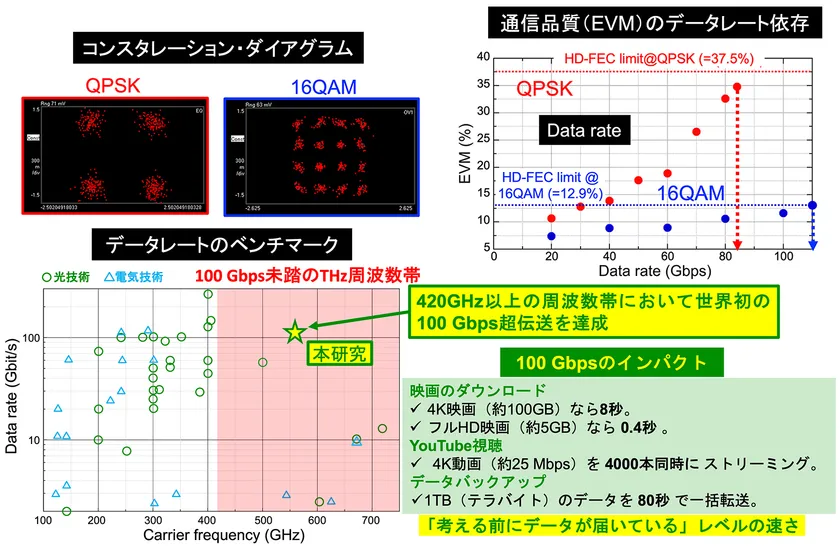
Figure3: Experimental results of terahertz wireless communication (demonstration of 100 Gbps-class transmission)
<Future Development>
This research has demonstrated the feasibility of 100 Gbps-class wireless communications in the terahertz band above 350 GHz, establishing an important technological foundation for the realization of ultrahigh-speed mobile backhaul communications and converged optical and wireless networks in 6G. In the future, further improvement of signal quality by further reducing phase noise of the micro-optical comb is expected to enable higher-order modulation schemes for even higher-speed and higher-capacity communications. In addition, to extend the practical communication range, it is effective to select a frequency band with low atmospheric absorption effect, as well as to increase the output power of terahertz waves and to introduce high-gain antennas. The combination of these technologies is expected to accelerate the practical application of terahertz wireless communications, and is expected to be applied to next-generation communication infrastructures.
Terminology.
(Note 1) Next-generation mobile communications (6G)
The next generation of mobile communications (6th generation mobile communications, 6G), which is expected to begin service in the 2030s, will use terahertz waves at 300 GHz or higher as the radio carrier. 6G is expected to provide "ultra high-speed and large capacity communications," "ultra low latency," "ultra extended coverage," "ultra highly reliable communications," "ultra low power consumption and low cost," and "ultra multiple connections. cost," "ultra-low power consumption and cost," and "ultra-multiple connections and sensing.
(Note 2) Fiber Optic Connected Micro Optical Comb
Micro-optic comb has an ultra-discrete multispectral structure with multiple optical frequency mode rows standing in equal intervals like the teeth of a comb, and can generate ultra-high frequency optical-electrical frequency signals of orders of magnitude higher quality than electrical methods. Furthermore, since they can be mass-produced in batches using semiconductor processes, they are expected to be ultra-compact, simple, and low-cost in the future.
The optical fiber-coupled system used in this research has significant advantages for practical applications, such as high coupling stability and reproducibility by directly coupling an optical fiber to a micro optical resonator and eliminating the need for precise optical tuning that has been required in the past.
(Note 3)Photonic 6G
Photonic 6G" is a registered trademark of Tokushima University (Registration No. 6537005).
Acknowledgments
In addition to Tokushima University and Gifu University mentioned above, this research was supported by Professor Atsushi Kanno of Nagoya Institute of Technology, Associate Professor Yasuhiro Okamura of University of Yamanashi, Senior Researcher Isao Morohashi of National Institute of Information and Communications Technology, and Researcher Yoshihiro Makimoto of Tokushima Prefectural Industrial Technology Center.
This research and development was supported by the Ministry of Internal Affairs and Communications (MIC) under its "Research and Development for Expansion of Radio Resources: Research and Development of Ultra-High Frequency Band High Capacity Communication Technology by Radio-Optical Interconversion (JPJ000254)" and by the Fundamental Technology Research and Development Project for Effective Utilization of Radio Waves (FORWARD) under its "Research and Development of Optical Comb-Driven Terahertz Reference Signal Source for Next Generation Mobile Communications. The project was commissioned by "Research and Development of Optical Comb-Driven Terahertz Reference Frequency Signal Source for Next Generation Mobile Communications (JPMI240910001)". The project was also supported by the "Next Generation Hikari Tokushima" project of Tokushima Prefecture, a grant project by the Cabinet Office for the creation of local universities and regional industries, and by the Japan Society for the Promotion of Science (JSPS) under the "Project for Strengthening Regional Core and Distinctive Research Universities (J-PEAKS) (JP-PEAKS)" (JPMI 240910001). PEAKS) (JPJS00420240022) by the Japan Society for the Promotion of Science (JSPS), and a grant from Tokushima Prefecture for the Project for Creation of Local Universities and Regional Industries.
Publication information
Journal: Communications Engineering
Title of paper: Beyond 350 GHz: Single-channel 112 Gbps photonic wireless transmission at 560 GHz using soliton microcombs
Author(s): Yu Tokizane, Hiroki Kishikawa, Takumi Kikuhara, Miezel Talara, Yoshihiro Makimoto, Kodai Yamaji, Yasuhiro Okamura, Kenji Nishimoto, Eiji Hase, Isao Morohashi, Atsushi Isao Morohashi, Atsushi Kanno, Shintaro Hisatake, Naoya Kuse, Tadao Nagatsuma, and Takeshi Yasui
DOI number: 10.1038/s44172-026-00659-8
Related patents
Three related patents applied for
Image
Logo Image

- Category:
- Technology & Development
- Genres:
- Medical care Technology Economy(Japan)