
[Survey Results] Parts Procurement: Concerns Grow Over Continued Supply, Not Just Price Increases
Index for Supply Disruptions and Proposals to Review Business Relationships Rises; Voices from the Field Say, “Even If We Have the Machinery, We Can’t Process the Material” —Japan Purchasing Professionals Index (JPI), September 2026 Survey
Future Procurement Research Institute, Inc.

Future Procurement Research Institute, Inc. (Chiyoda-ku, Tokyo) launched the “Japan Purchasing Professionals Index (JPI),” a new economic indicator surveyed monthly among corporate procurement and purchasing professionals, and released its first set of survey results on September 11, 2026. In the September survey, the index indicating supply suspensions or requests to review business relationships from suppliers rose from 47.7 the previous month to 55.2. This highlights that, in addition to price increases, concerns about the continued supply of components themselves are spreading among procurement professionals.
In the procurement of parts and materials, concerns about the continuity of supply are emerging alongside price increases. In the Future Procurement Research Institute’s September 2026 survey, the index indicating changes in inquiries from suppliers regarding supply suspensions or business reviews rose from 47.7 the previous month to 55.2. After falling below 50 in July and August, the index returned to above 50, indicating an increase (the first time in three months).
The survey compiled responses from 86 procurement and purchasing managers. In the open-ended comments, respondents cited labor shortages, noting that “even with the machinery, we cannot perform machining,” and mentioned that they are “placing firm orders up to a year in advance” to prepare for extended semiconductor delivery times.
The purchase price index stands at a high level of 85.5. In corporate procurement departments, securing the supply of necessary components—alongside price negotiations—has become a key challenge.
■ Voices from the Field (from open-ended comments)
・One respondent noted that delivery times for electronic components have become noticeably longer, and suppliers are now responding with statements indicating they are “nearly halting supply.”
・One respondent noted that delivery delays from overseas semiconductor manufacturers are severe and, anticipating that the disruption will continue until the end of 2028, stated, “We are responding by placing firm orders up to one year in advance.” Some also pointed to the impact of demand for AI servers.
・Domestically, one respondent noted, “Even if we have the machinery, there’s no one to operate it.” This highlighted the supplier’s situation, where they are unable to meet demand due to labor shortages despite being in a period of increased production.
・There were also reports of concerns regarding potential delays in shipments from Europe.
■ By the Numbers
The Composite JPI, which measures the “difficulty of procuring goods” for companies, stood at 62.8 (63.8 last month). This marks the fourth consecutive month since June that the index has remained above 50, indicating that procurement has become more difficult, following last month’s trend. However, the degree of difficulty has decreased compared to last month.
By category, the purchase price index was the highest at 85.5, significantly exceeding the indices for order volume (54.7) and the number of requests for quotes (54.1). The index for supply suspensions and proposals to review business relationships stood at 55.2, rising above 50 after falling below that level in July (47.8) and August (47.7).
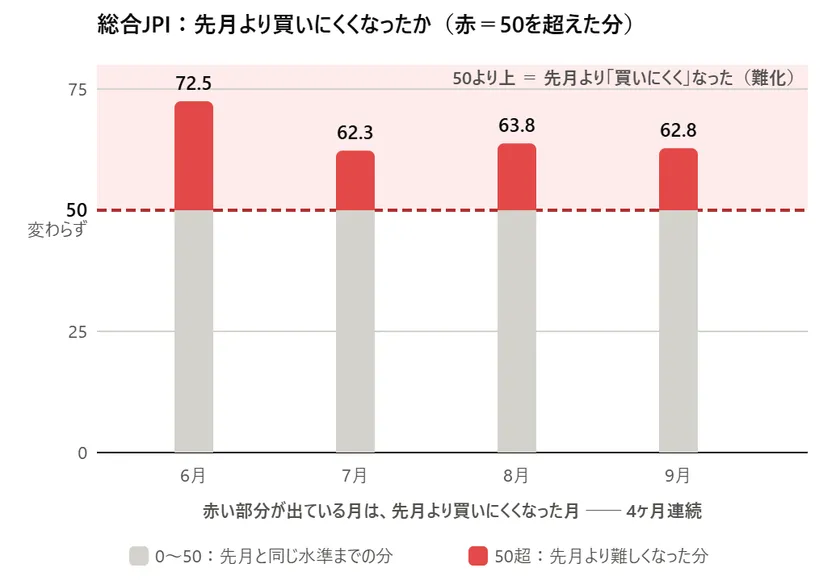
Composite JPI (Has it become harder to purchase compared to last month?)—The red portion indicates the extent to which the index “exceeded 50.” It has remained above 50 for four consecutive months since June.
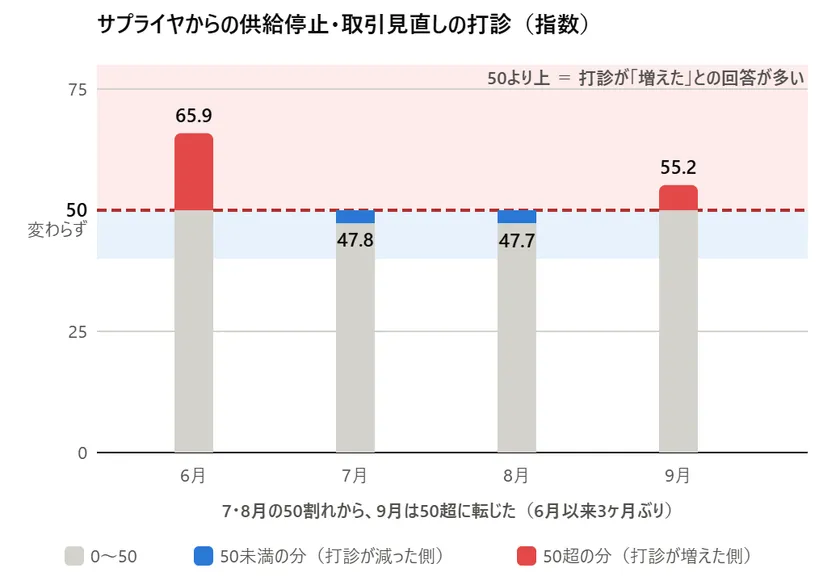
Index of inquiries from suppliers regarding supply suspensions or contract revisions—After falling below 50 in July and August, it rose above 50 in September
■ Expert Commentary
Takanori Sakaguchi, Future Procurement Research Institute Inc. (Procurement and Supply Chain Consultant)
“Following price hikes, concerns have emerged on the procurement front about whether supplies themselves will continue. In September, there was an increase in responses indicating that suppliers had approached them regarding supply suspensions or business reviews. I believe this is driven by longer lead times for semiconductors and domestic labor shortages. Some respondents mentioned that they are responding by finalizing orders up to a year in advance. If these trends spread, they could begin to affect product prices and delivery times.”
■What is the Japan Purchasing Professionals Index (JPI)?
The Japan Purchasing Professionals Index (JPI) is an index that measures the “difficulty of purchasing goods” for companies. It is compiled by asking procurement and purchasing managers—who buy parts, materials, and services for their companies—the same five questions every month (Has the purchase price increased? / Were deliveries delayed? / Did order volumes increase? / Have requests for quotes increased? / Have suppliers approached you regarding supply suspensions or a review of the business relationship?).
The index value for each item is calculated by adding the percentage of respondents who answered “Yes” to half the percentage who answered “No change”; if all respondents answered “No change,” the value would be 50. The Composite JPI is the simple average of the five sub-indices. Increases in order volumes and requests for quotes are counted as factors contributing to “difficulty in purchasing,” as they serve as leading indicators that delivery times and prices will become tighter as demand strengthens. A value above 50 indicates that it has become harder to purchase compared to the previous month, while a value below 50 indicates that it has become easier. Like the U.S. ISM Manufacturing PMI, this is a monthly survey of purchasing managers, but the questions and calculation formula are designed independently. The survey is conducted from the 1st to the 10th of each month and released on the 11th.
■ Participation in the Survey and Media Inquiries
JPI is always seeking purchasing and procurement professionals to participate in the survey (free to participate; monthly summary reports are provided). We also provide commentary on survey results and are available for interviews and comments regarding procurement, supply chains, the economy, and prices. Takanori Sakaguchi, a procurement and supply chain expert, provides commentary on television, radio, and other media.
■ Survey Overview
Survey Organizer: Future Procurement Research Institute Inc.
Target Audience: Corporate procurement and purchasing professionals
Period: September 1–10, 2026
Publication: The 11th of each month (publication begins this month)
■(Reference) Data Details
Indices by Category: Purchase Price 85.5 / Delivery Delays 64.5 / Order Volume 54.7 / Number of Requests for Quotes 54.1 / Discussions on Supply Suspensions or Business Review 55.2 (47.7 last month)
Composite JPI: 62.8 (last month: 63.8) / Current: 75.0, Leading: 54.4, Risk: 55.2 / Number of valid responses: 86
Recent trends in the Composite JPI: June 72.5 → July 62.3 → August 63.8 → September 62.8
Recent trends in inquiries regarding supply suspensions and business review: June 65.9 → July 47.8 → August 47.7 → September 55.2
■Company Overview
Company Name: Future Procurement Research Institute, Inc.
Address: 4th Floor, Musée Kojimachi, 6-4-9 Kojimachi, Chiyoda-ku, Tokyo 102-0083
Business Activities: Consulting, research, and training related to procurement, purchasing, and supply chains
Image
Logo Image

- Category:
- Research & Reports