
Tokyu Agency, Mitsubishi Shokuhin, and unerry Launch a Service to Visualize the Purchasing Effectiveness of OOH Advertising (Retail Media Impact)
~Preliminary testing confirmed that the purchase rate among those exposed to OOH advertising is approximately twice that of those who were not exposed~
株式会社東急エージェンシー 三菱食品株式会社 株式会社unerry

Tokyu Agency Co., Ltd., Mitsubishi Shokuhin Co., Ltd., and unerry Co., Ltd. will begin offering a service on June 25, 2026, that visualizes the impact (retail media impact) of OOH (Out-of-Home) advertising—specifically targeting the Tokyu Line corridor—from ad exposure through to purchase.
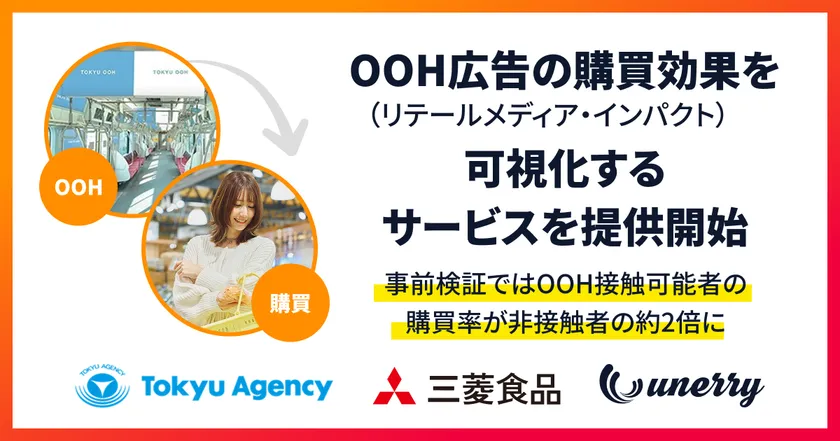
Launch of Service to Visualize Retail Media Impact
By linking ID-POS data with location data, this service makes it possible to quantitatively evaluate the contribution of OOH advertising to purchases—a metric that was previously difficult to measure. Preliminary testing (in the beverage category) confirmed that the purchase rate for the target products among individuals exposed to OOH advertising was approximately twice that of those not exposed.
Please note that the data handled through this integration does not contain any personal information, and the data integration is conducted in a secure environment with due consideration for privacy.
■ Purpose and Background
In recent years, while OOH advertising has been reevaluated as an opportunity for brand exposure, the question of “to what extent it contributes to actual purchases” has been recognized as a key challenge in corporate marketing activities.
However, unlike digital advertising, OOH advertising has traditionally posed challenges in directly measuring conversions, resulting in limited insight into return on investment (ROI).
Against this backdrop, the three companies have decided to jointly provide a service that verifies the effectiveness of OOH advertising by linking it to purchase data.
■ Service Overview and Features
This service quantitatively visualizes the effectiveness of OOH advertising (including outdoor, transit, and in-store digital signage) along the Tokyu Line, measuring not only whether consumers “saw the ad (or were likely to see it)” but also whether it “actually led to a purchase.”
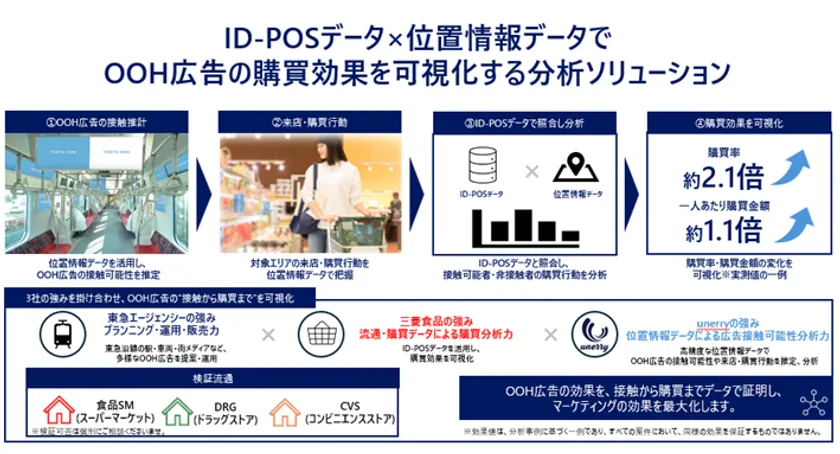
An analytical solution that visualizes the purchase impact of OOH advertising using ID-POS data and location data
(Feature 1) Integrated Analysis of OOH Advertising and Purchase Data
By utilizing retail data along the Tokyu Line (limited to authorized data), we accurately assess the potential exposure to OOH advertising for approximately 5 million people who use the Tokyu Line.
(Feature 2) Quantitative Verification of Purchase Effectiveness
By comparing individuals exposed to the ads with those not exposed, we calculate purchase effectiveness (purchase rate and average purchase amount per person). Preliminary verification has clearly confirmed the effectiveness of OOH advertising; for example, the purchase rate among those exposed to multiple media channels was approximately 1.9 times higher than that of non-exposed individuals.
(Feature 3) Visualization of the Effects of Multi-Channel Media Exposure
In addition to station ads, train car ads, and street media, we can analyze the effects of both standalone and combined exposure, including digital ads. (For digital ads, delivery planning designed for analysis is required.)
■ Purchase Lift Confirmed in Preliminary Testing
1. Beverage Category A
We measured the purchasing behavior of individuals exposed to and not exposed to advertisements displayed on two large digital billboards in Shibuya.
- Individuals exposed to a single medium: Purchase rate was approximately 1.8 times that of non-exposed individuals
- Audience exposed to both media: Purchase rate was approximately 1.9 times that of the non-exposed group
We confirmed a trend where purchase rates increase with repeated media exposure, quantitatively demonstrating the effectiveness of planning that combines multiple OOH media. The improvement in purchase rates achieved through “combined exposure”—which creates multiple touchpoints along daily routes such as stations, trains, and city streets—is a unique strength of advertising campaigns linked to this service.
2. Beverage Category B
For advertisements displayed on trains, results confirmed that the purchase rate for the target product among those exposed to the ads during the campaign period was approximately twice that of non-exposed individuals, and the average purchase amount per person was approximately 1.1 times higher.
A key feature of this service is the ability to evaluate its contribution to purchases using a single metric, regardless of media type—from large-screen displays at stations and in city centers to train car advertisements.
Furthermore, through a series of pilot studies, it was confirmed that the audience reachable by OOH along the Tokyu Line consists of consumers who are close to purchase touchpoints at target stores, thereby substantiating the media characteristic of Tokyu OOH: “reaching consumers along their daily shopping routes.”
■Roles of Each Company
・Tokyu Agency
Responsible for OOH advertising planning, operations, and sales
Provides location data (TOQ MOBILE ID) derived from beacons installed by the company as part of the Phygital Syndicate*1 initiative
・Mitsubishi Shokuhin
As part of the DD Marketing※2 initiative, responsible for purchase analysis and calculating purchase lift using distribution and purchase data
・unerry
As part of the “Beacon Bank for OOH”※3 initiative—an OOH advertising effectiveness measurement service—responsible for estimating and analyzing ad exposure, store visits, and purchasing behavior using location data
*1 Phygital Syndicate: A project promoted by Tokyu Agency to advance “Phygital” (physical + digital). It promotes the utilization of TOKYU OOH—a physical medium—from various perspectives, including expression methods using digital technology and effectiveness measurement utilizing location data.
*2 DD Marketing: A new form of marketing promoted by Mitsubishi Shokuhin that combines data analysis and digital marketing to propose effective customer acquisition and advertising/promotional strategies to retailers and manufacturers.Building on long-standing relationships with 3,000 retailers and 6,500 manufacturers, this initiative leverages approximately 1.2 billion data points collected annually through this business, along with consumer touchpoints gained through retail support, to solve challenges in the food distribution industry.
*3 Beacon Bank for OOH: An OOH (Out-of-Home) media effectiveness measurement service operated by unerry that utilizes the “Beacon Bank” real-world behavioral data platform.
■ Future Outlook
Going forward, in addition to improving analytical accuracy, we will expand our distribution data and media channels and advance data integration to standardize the visualization of effectiveness in the OOH advertising market.
■Company Overview
Tokyu Agency Co., Ltd.
Representative Director, President and CEO: Toshiyuki Takasaka
Address: Hibiya Fort Tower, 1-1-1 Nishi-Shimbashi, Minato-ku, Tokyo
Established in 1961 as the Tokyu Group’s comprehensive advertising agency. Guided by the vision “To become a company that co-creates experiential value by working side-by-side with our clients to drive their business growth,” we provide solutions that integrate mass media, digital, and the Tokyu Group’s physical customer touchpoints.
Mitsubishi Shokuhin Co., Ltd.
President and CEO: Kazuo Ito
Address: 1-1-1 Koishikawa, Bunkyo-ku, Tokyo
The company’s primary business involves the wholesale of processed foods, chilled foods, alcoholic beverages, and confectionery both domestically and internationally, and it also operates logistics and other service-related businesses. In 2025, the company celebrated the 100th anniversary of the founding of its predecessor company.
unerry Co., Ltd.
President and CEO: Hidetoshi Uchiyama
Address: 19th Floor, Hibiya Park Front, 2-1-6 Uchisaiwaicho, Chiyoda-ku, Tokyo
Founded in 2015, we are a data company that operates “Beacon Bank,” a real-world behavioral data platform.Utilizing GPS and beacon technology, the company uses AI to analyze big data on indoor and outdoor foot traffic—comprising approximately 850 million IDs (of which approximately 240 million are from Japan)—collected from about 150 smartphone apps. Its mission is “Creating a Comfortable Future with Data.”
Image
Logo Image

- Category:
- Corporate Trends