
N-E.X.T. High School Initiative Started recruiting co-creation partners for the first phase of "Good Implementation
Ambiguity in proposal comparison, stalling of initial 90-day operation, and nonconformity to regional differences, One-school-stopping results -- for persistent challenges, Co-design with prefectural boards of education, schools, universities, and local industry, to improve and make knowledge
笹埜健斗研究室

Kento Sasano (Professor at Okayama University) will begin accepting applications from prefectural boards of education, school administrators, universities, research institutions, regional organizations, and businesses for the first phase of "Good Implementation" research implementation partners on Tuesday, April 28, 2026, in order to materialize the N-E.X.T. High School concept as "reform that keeps going around the community" rather than "reform that ends with its introduction. The call for proposals will open on Tuesday, April 28, 2026.
This call is in response to persistent issues that repeatedly appear in the field of high school reform, such as: the criteria for proposal comparison are likely to be ambiguous; operational design in the first 90 days after implementation is weak and likely to stall before taking root; implementation design based on regional and school differences is likely to be lacking; and results stop at one school and are unlikely to become knowledge for dissemination in the region, This is a framework for stakeholders to collaborate in design, operation, improvement, and knowledge generation.
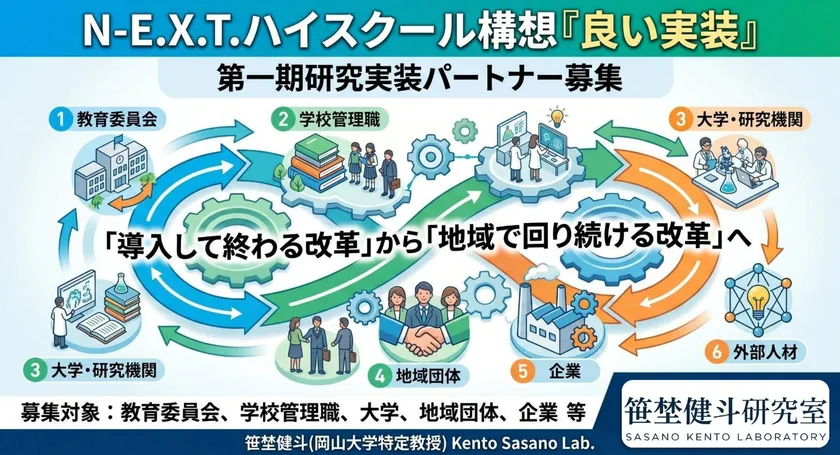
Call for Research Implementation Partners for the First Phase
On February 13, 2026, the Ministry of Education, Culture, Sports, Science and Technology (MEXT) released its "Basic Policy on High School Education Reform (Grand Design)" and on the same day began accepting applications for pilot cases utilizing the approximately 300 billion yen "Fund for Promoting High School Education Reform. The Ministry of Education, Culture, Sports, Science and Technology (MEXT) has indicated that each prefecture will formulate an action plan based on the grand design, establish a center for leading reforms in accordance with three categories, and disseminate the initiatives and results to high schools in the region. (3) educational opportunities that meet diverse learning needs.
In addition, MEXT materials indicate that in building a collaborative system in prefectures, the Fund will utilize the Comprehensive Education Council and the Local Industrial Education Council, collaborate with various stakeholders, build consortiums, and collaborate with regional concept promotion platforms, etc. In addition, in addition to the "creation of centers for leading reforms," the Fund's eligible expenses include "expenses for accompanying the acceleration of high school education reform," which are expected to include progress checks and evaluations, sharing of know-how for each type of reform, and support from experts.
The Guidelines for Public Call for Proposals stipulate that the third round of applications must arrive no later than 12:00 p.m. on May 15, 2026 (Friday), and list the following items to be reviewed: issue setting in each prefecture, promotion system, cooperation and collaboration with external organizations, strategies for initiatives and results dissemination, improvement of teacher qualifications and abilities and sustainable work environment, and effective and efficient use of expenses. The following are listed in the table. It also clearly states that it will not accept questions or consultations regarding business plans for individual Reform Leading Centers. Therefore, what is needed now is not mere application support, but a research implementation-style accompaniment that allows each region to make its own axis of judgment, design the division of roles with related parties, and make improvements as the initial operations are carried out.
This call for research-implementation partners follows the DBIR approach from a research perspective, starting from the persistent issues seen from multiple parties, and through co-design and iterative improvement, we aim to capture both changes in learning and conditions for implementation, and create implementation knowledge that can be reused in the next region or school. We will not only introduce case studies in public relations, but also organize the criteria for comparing proposals, how to form a cooperative system, the intuition for initial 90-day operation, and the conditions necessary for regional diffusion, and return them to society as implementation knowledge for the N-E.X.T. High School Initiative.
Main areas of co-creation
(1) Support for the development of advanced essential workers, etc.
In fields that support local industry, society, and infrastructure, we will collaborate with institutions of higher education, the community, and industry to co-design implementation, including department and course restructuring, school courses, the use of new technologies, and the appointment of external human resources.
(2) Support for human resource development in science and mathematics
Based on science and mathematics backgrounds, we will jointly design programs that provide students with the opportunity to ask and solve their own questions, integrate arts and sciences, create centers of science and mathematics exploration, and connect students to career paths.
(3) Securing educational opportunities that meet diverse learning needs
In light of the declining population and geographical constraints, we will work to ensure learning by utilizing local resources and remote classes, improve academic performance and learning support by utilizing after-school hours, and expand learning options through collaboration with external organizations.
■ Co-creation Process
(1) Phase 1: Clarification of persistent issues
This is the stage to define "sustainable issues from the viewpoints of multiple parties," which is the starting point of DBIR, in line with the policy implementation of the N-E.X.T. High School Concept.
(2) Phase 2: Co-design
Using the evaluation guide released in Phase 1, the decision criteria organized in Phase 2, and the public and internal versions of the toolkit, the decision axis, division of roles, meeting body, and 90-day plan will be jointly designed. This is the process of translating the MEXT's required implementation plan, collaboration structure, and results dissemination strategy into a form that can be implemented in the field.
(3) Phase 3: Initial 90-day operation and mid-term review
This is the stage in which the iterative and collaborative design principles of DBIR are incorporated into the initial operation of the N-E.X.T. High School Initiative.
(4) Phase 4: Knowledge Making and Intra-Regional Dissemination
To the extent possible to be anonymized, the decision criteria, division of roles, operational conditions, and conditions for dissemination are organized and converted into reusable implementation knowledge that does not end with the completion of a single school. While responding to the Ministry of Education, Culture, Sports, Science and Technology's demand for "intra-regional dissemination of initiatives and results," we will leave behind knowledge that is meaningful both as research and as implementation.
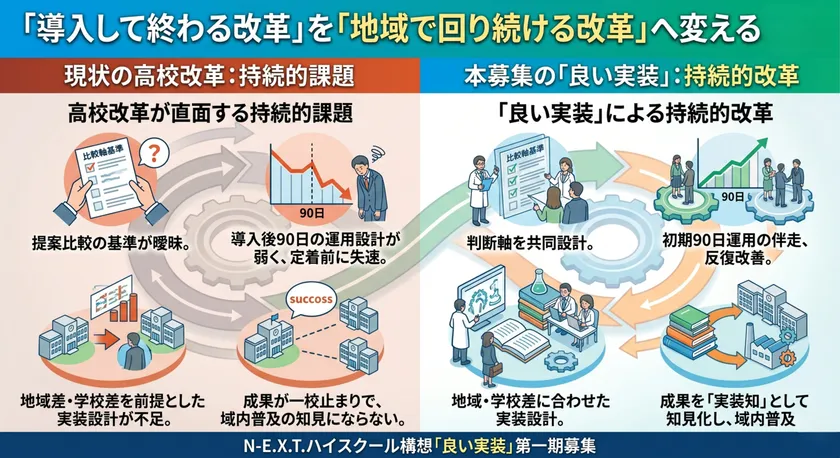
Transformation into "reform that continues to revolve around the region
Targets
Prefectural boards of education, municipal boards of education, school administrators, and those in charge of promoting inquiry and information education
Universities and research institutes involved in high school education reform
Local companies, economic organizations, NPOs, out-of-school educational institutions, community partnership organizations
Media, researchers, and support organizations interested in visualization, verification, and sharing of implementation knowledge
■Outline of Acceptance
(1) Application name
N-E.X.T. High School Initiative "Good Implementation" First Stage Call for Research Implementation Partners
(2) Start of acceptance
Tuesday, April 28, 2026
(3) Deadline for first phase priority consultation
Wednesday, May 13, 2026, 17:00
(4) How to apply
Application is accepted through the dedicated form ( https://forms.gle/cuFxctKNxDJsydgr8 )
Kento Sasano Comment
"I believe that the real question in the N-E.X.T. High School concept is not only what to put in, but also what issues to face, with whom to partner, how to improve, and what knowledge to leave in the community. I see this call not only as a way to gather collaborators, but also as an entry point for school boards, schools, universities, and local industries to collaborate in designing, testing, and reviewing solutions to persistent problems in the field, and to create implementation knowledge that can be applied to the next stage of the project. We hope that the N-E.X.T. High School Initiative will not end as a partial success story, but will lead to reforms that will enable each region to run on its own.
■Profile
Kento Sasano
Professor at Okayama University. He is also a senior research fellow at Keio Research Institute at SFC, Keio University, and president of the Japan Education DX Promotion Association. He specializes in designing individualized, optimal, and collaborative learning experiences using AI. He is conducting research and social implementation of Education DX, inquiry learning, and learning design. He has appeared in the media and provided information for Fuji Television's "Honma dekka! TV" and other media appearances and information dissemination.
For inquiries, please contact
Kento Sasano Lab.
Application form: https://forms.gle/cuFxctKNxDJsydgr8
Public page: https://sasano.org/
Application for interview: https://sasano.org/#contact/
Note
This is not a publicly solicited project by the Ministry of Education, Culture, Sports, Science and Technology (MEXT) itself, but a research implementation and co-creation partnership by Kento Sasano Lab. The application to the fund itself must be made by each prefectural board of education, etc.
Image
Logo Image

- Category:
- Services