
SHOKAY Care Program Part 2 [Laundry The most creative choice is to take care of your existing clothes wisely. the most creative choice!
~The 7 Habits of Smart Knitwear Care - Shampooing and Washing Knitwear for a Fluffy Finish Seven Habits of Smart Knit Care
SHOKAY・DGBH(ダブルツリー株式会社)

SHOKAY, a regenerative material brand focusing on "yak" materials (operated by Doubletree, Inc.; headquartered in Sapporo, Hokkaido; Tamiko Hayashi, Representative Director), has released its second care information series, "SHOKAY Care Program - Laundry Edition," on the SHOKAY (Head office: Sapporo, Hokkaido; President: Tamiko Hayashi) has released the second in a series of care information series, "SHOKAY Care Program - Laundry Edition" on the SHOKAY official website (http://shokay.jp).

SHOKAY "Smart Knit Care
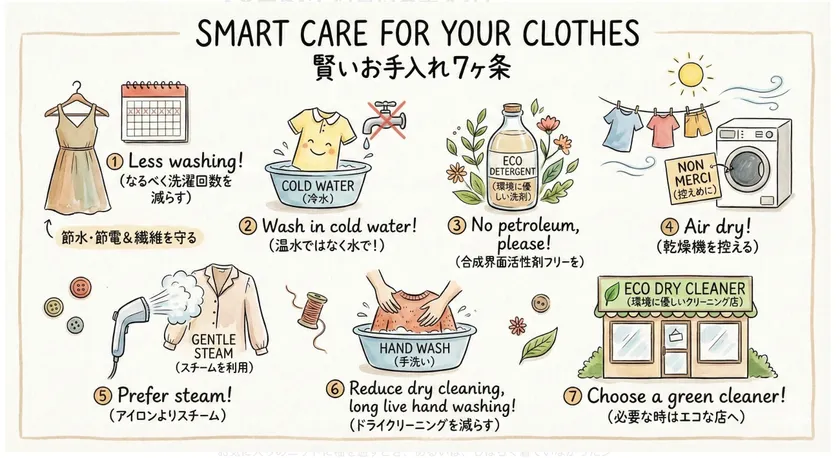
Seven Habits of Smart Care
This content is a series produced by DGBH under the theme of "Mindful Style × Happy Closet," and provides care information to ensure long-lasting use of high-quality SHOKAY yaknit products. In this issue, we introduce the "Seven Habits of Smart Knit Care" from the International Textile Trade Fair in Paris, France, and the knitwear washing technique that Tamiko Hayashi, the president of SHOKAY, has practiced for many years, along with easy-to-understand illustrations.
Background: In an age of "taking good care of existing clothes" rather than "buying new clothes
When we put on our favorite knitwear, it has become more natural than ever before to think about how we can build a long-lasting and good relationship with this clothing. The fashion industry is the second most environmentally burdensome industry in the world. In this context, "taking good care of the clothes we have" is the most creative and sustainable choice.
The concept of the "Seven Habits of Smart Knit Care," which was proposed at the Première Vision (PV) international textile fair in Paris, France in 2017, is now becoming a global standard.
The "7 Smart Knit Care Habits" are now a global standard. 8 years later, it has not faded away. In France, the installation of filters in new washing machines is becoming mandatory. The practice of washing clothes in cold water is an important action that not only prolongs the life of clothes, but also directly contributes to the prevention of marine pollution.
Seven Habits of Smart Knit Care (Methods practiced by ethical brands around the world)
These 7 habits were introduced in a session produced by C.L.A.S.S. (Creativity Lifestyle and Sustainable Synergy) representative Gigi Bettoni at the "Smart Creation Square" in Première Vision (PV) Paris in 2017. The seven habits were introduced at a session produced by Gigi Bettoni, President of Creativity Lifestyle and Sustainable Synergy.
(1) Reduce the number of times you use the washing machine
In addition to saving water and energy, the act of washing clothes damages fibers. Reexamining the habit of washing clothes every time you wear them will greatly extend the life of your clothes.
(2) Wash in cold or room temperature water, not warm water
Hot water damages fibers and causes shrinkage. Cold water washing also inhibits microplastic shedding. It is a gentle choice for both the earth and the clothes.
(3) Choose environmentally friendly detergents
Use detergents with vegetable or natural ingredients that do not contain petroleum-derived synthetic surfactants. Neutral detergent is the basic choice for knitwear.
(4) Avoid using a dryer.
High temperatures and friction can cause serious damage to knit fibers. Ideally, dry the garment flat in the shade in a well-ventilated place, keeping it in shape.
(5) Use steam rather than an iron
Directly applying an iron will put a load on the fibers. By using a steam iron with the iron slightly elevated, you can remove wrinkles and care for the fibers at the same time.
(6) Hand washing is preferred over dry cleaning
Solvents used in dry cleaning have an environmental impact. For most knitwear, careful hand washing is sufficient.
(7) If dry cleaning is absolutely necessary, choose a green store.
Solvent-free dry cleaners are increasing in Japan. Natural Clean" (Isetan Shinjuku, Chiba, etc.) and "Happy" (Kyoto, nationwide home delivery) are attracting attention.
SHOKAY Japan Representative Hayashi's Knit Washing Technique for Those in the Know
People are animals, so we should take care of our knitwear the same way we take care of our hair. --A professional at a well-known high-end clothing dry cleaner in Tokyo told me something that really caught my eye.
When I used to be in charge of public relations for a luxury brand in Europe and the United States, I had the opportunity to visit a high-end garment cleaning store in Tokyo. The laundry technique I learned from the professionals there remains my favorite method to this day.
■What to use instead of detergent / Key points
<Shampoo + conditioner
You can use what you normally use, but it is best for yak, cashmere, and wool, which are "animal protein fibers" like hair. It is ideal for yak, cashmere, and wool, which have the same "animal protein fibers" as hair.
<Low-stimulus baby shampoo
The hypoallergenic formula for babies with sensitive skin is also safe for delicate high-grade knitwear. Especially suitable for those who want to keep their skin soft and comfortable.
<Tips for finishing
Fill a wash tub with cold water, dissolve a small amount of shampoo, and wash gently. Use conditioner when rinsing for a soft and fluffy finish.
<How to dry
Dry the hair lightly with a towel, shape it, and hang it to dry flat. Avoid direct sunlight and place in an airy shade.
This method is widely practiced among overseas fashion professionals, sustainable laundry experts, and the worldwide knitter community as a "smart care method" that is well known by those in the know.
■Yak Sweater Washing Quick Guide
<Things to do and recommendations
Hand wash in cold or room temperature water.
Use shampoo and conditioner.
Use neutral detergent (for knitwear only)
Towel dry and hang dry.
Steam iron (by lifting the garment)
Regular ventilation of closets
Minimum frequency of laundering according to the frequency of wear.
<Avoid
Washing in hot water
Strong spinning in the washing machine (even using a net)
Use of dryers
Drying in direct sunlight
Direct application of an iron.
Storing on hangers (causes loss of shape)
Washing after every wear (damages the fibers)
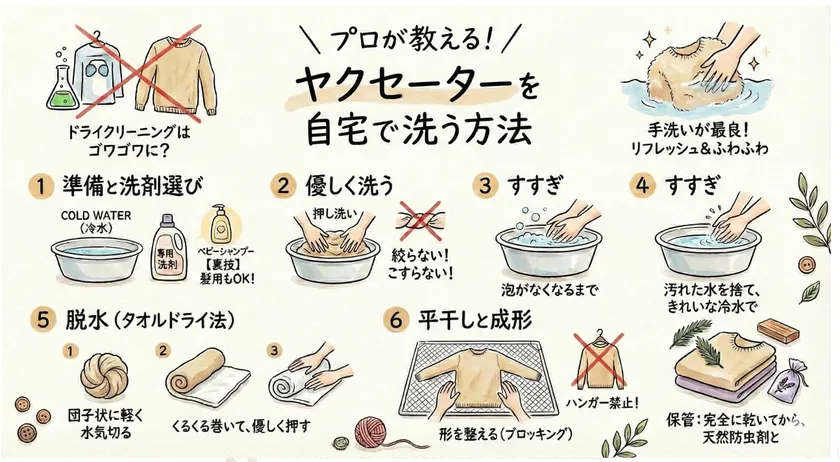
How to wash yak knitwear
About SHOKAY
SHOKAY is a social business founded in 2006 by two female students studying international cooperation at Harvard University's Kennedy School of Government, with the aim of solving poverty issues among the Tibetan people. As a pioneer of ethical knitwear, their founding story was published in the book "Sekai wo Chan Kaeru Oshigoto" (Kodansha, 2010).
Only 100g of yak hair is harvested from one cow per year, making it a rare material. It is said to retain heat better than cashmere, has excellent breathability and flexibility, and is resistant to pilling. The company produces and sells high-quality knit products and yarns while ensuring traceability. The brand contributes to the achievement of 12 of the 17 UN SDGs.
URL: http://shokay.jp
About DGBH
In 2010, DGBH produced "DGBH (DoGood, BeHappy!)," a one-year limited select store at Omotesando Hills that proposes an ethical lifestyle centered on SHOKAY. Since then, she has developed a wide range of businesses, including seminars, travel planning and management, product planning and development, and content creation, based on the concept of "living a happy life while enjoying a mindful lifestyle.
She is currently writing a series of articles in NOTE on the theme of "Happy Closet - ABC of Mindful Style" from the viewpoint of regenerative fashion that enriches and revitalizes the mind and life, and how to create a happy closet where clothes invite good fortune.
URL: https://note.com/dgbh/m/m43a5d530f1fc
Company Profile
Company name: Doubletree, Inc.
Location: Chuo-ku, Sapporo, Hokkaido
Representative Director: Tamiko Hayashi
Establishment : July 8, 2008
Main Business: (1) Sole distributor of ethical yak material brand "SHOKAY" in Japan
(2)Content planning and production business "DGBH (DoGood, BeHappy!)
Operation of seminars and travel plans under the theme of "Mindful Style × Happy Closet," product development, and content production.
DGBH operates seminars and travel planning, develops products, produces contents and disseminates information under the theme of "Mindful Style × Happy Closet".
(3) Vacation and vacation house business
We are developing "Okusasu Cottage," a cottage for rent in Niseko Town, Hokkaido, that combines forest therapy and retreats.
(3) Vacation/Working house business: "Okusuri Farm" (in preparation), a cottage for rent in Niseko Town, Hokkaido, that combines forest therapy and retreat.
Profile of Representative Director Tamiko Hayashi
After working for a foreign entertainment company, a publisher of VOGUE NIPPON, and in PR for European and American fashion brands, she established the NPO "Social Concierge" in 2007. She has practiced yoga and meditation for over 30 years and has completed the Tatsumura Yoga for Health Teacher Training Course. She is certified as a forest therapy guide in the United States. She has also completed the "Forest Medical Trainer" training course certified by Shinano-cho, Nagano Prefecture, and is a member of the Shinano-cho Forest Therapy Study Group "Hitotsuki no Kai". Currently, she is preparing "Okusuri Farm," a one-room retreat cottage offering forest therapy programs in Niseko Town, Hokkaido. On her Instagram page, she shares her daily life in Hokkaido, living in Sapporo and Niseko.
URL : https://www.instagram.com/tamikohayashi/
Instagram: @tamikohayashi
Image

Logo Image

- Category:
- Goods