
The Key to Successful Telework is a "Light Environment University Collaborative Study Using Children's Mirai STRESCOPE Data Finds
~ "Morning Light" and "Night Screen Restrictions" via Sleep Improving Mental Health and Productivity~.
株式会社こどもみらい

Kodomo Mirai Co. (Head Office: Kita-ku, Tokyo; Representative Director: Yusaku Akatsuka), and the University of Tokyo (Dr. Tetsuyoshi Shimura, visiting professor in the Department of Sleep Science, Tokyo Medical University, and Dr. Yuji Furui, specially-appointed professor at the Future Vision Research Center), have published the results of their joint research on March 3, 2026, in Chronobiology International, a leading international journal in the field of biological clock research. The results of the joint research led by Tokyo Medical University (Tetsuyoshi Shimura, Visiting Professor, Department of Sleep Science) and the University of Tokyo (Yuji Furui, Project Professor, Future Vision Research Center) were published on March 3, 2026 in Chronobiology International, a leading international journal in the field of biological clock research.
Link to the article
https://www.tandfonline.com/doi/full/10.1080/07420528.2026.2636741
This study reveals the importance of sleep for healthy and productive teleworking and that "light environment" is a critical factor in the changes in sleep.
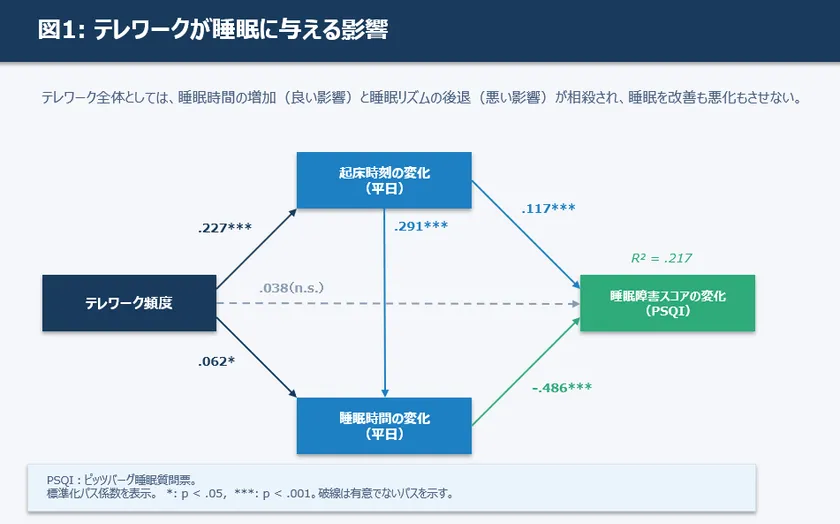
Effects of Telework on Sleep
■ Background of the study: How does telework affect sleep, mental health, and productivity?
Telework (remote work), which spread rapidly in the wake of the new coronavirus infection (COVID-19), is still firmly established in many workplaces today. While increasing flexibility in work styles, such as reducing commuting time, health risks such as "disruption of rhythm" and "blurring of on/off boundaries" were also pointed out. However, until now there have been few large-scale longitudinal studies that have clarified how telework affects workers' sleep, mental health, and productivity, while tracking individual changes.
■Study Summary: Analysis of Changes Before and After the Start of Telework
This study included 23 companies and a total of 3,123 users of the Children's Mirai stress check "STRESCOPE" who had agreed to use their data for academic purposes and who were not teleworking in 2019 and who introduced telework in 2020. 2019 (pre-Corona) and 2020 Data were collected at two time points in 2019 (Corona disaster). Changes in sleep quality, sleep schedule, sleep hygiene (light environment), stress response, and presenteeism (state of reduced productivity due to physical and mental illness despite being at work) were analyzed before and after the start of telework.
Main findings: Positive/negative aspects of telework and the importance of the light environment.
[It became clear that the "positive" and "negative" aspects of teleworking have conflicting effects on sleep.
● Teleworkers who began teleworking extended their weekday sleep time by an average of about 13 minutes, mainly due to reduced commuting time. An increase in sleep time leads to improved sleep.
On the other hand, a regression of sleep rhythm (internal body clock) was also observed, as the average wake-up time became about 19 minutes later. Disturbances in sleep rhythm worsen sleep.
The results showed that telework as a whole neither improved nor worsened sleep, because these two opposing effects canceled each other out.
Sleep problems significantly contribute to both stress reactions and presenteeism, indicating that sleep management is the key to workplace health in telework.
The importance of sleep hygiene (light environment)
Comparing teleworker initiators by environment for "morning light environment" and "display use before bedtime," we found that there were significant differences.
Those in a bright bedroom environment with daylight in the morning improved both their stress response and work productivity following telework initiation. Conversely, the group in the environment with inadequate morning light showed a regression in sleep rhythm and associated worsening of sleep and presenteeism.
Similarly, both sleep quality scores and stress response scores improved in the group that did not use a smartphone, PC, or other display before bedtime.
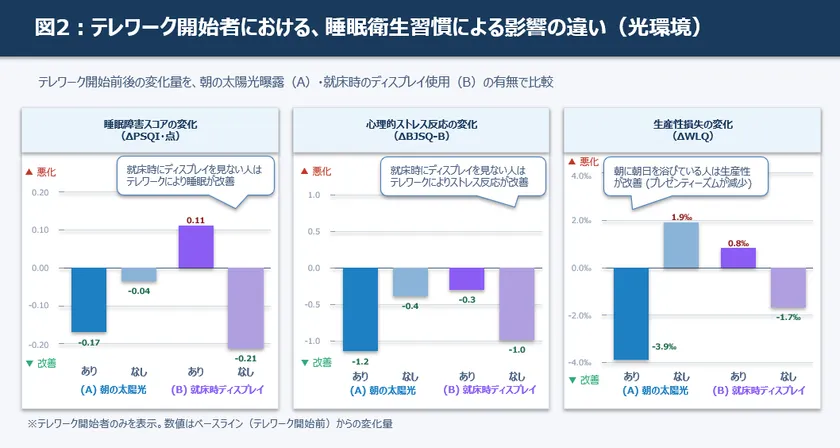
Differences in Effects of Sleep Hygiene Practices (Light Environment) Among Teleworkers Who Started Teleworking
■ Research shows that the key points of healthy teleworking practices
1. make sure you get enough sleep
Avoid night owl and prevent sleep rhythm regression. 3.
● 3. get plenty of morning light (sunlight) (to reset the body clock) ● 4.
4. refrain from using smartphones, PCs, and tablets before going to bed at night.
We often do not have much exposure to sunlight at home. There is an idiomatic expression that "strong morning light resets the body's internal clock," but in technical terms it is called a "Zeitgeber" (time-setting signal). While many office workers may be able to adjust their internal clocks by going outdoors to receive sunlight during their commute, when commuting is eliminated due to teleworking, they lose the opportunity to receive morning sunlight, which can easily disrupt their internal clocks and sleep rhythms.
In addition, if people stay at home and work on their PCs until late at night, the light from the display will enter their eyes even late at night, giving the body the illusion that it is not yet night, which can similarly disrupt the body's internal clock.
The "secret to successful teleworking," as indicated by this study, is to provide a strong light environment in the morning, avoid exposure to PC and smartphone light late at night, and use the time saved from commuting to work to get a good night's sleep. And improved sleep is directly linked to reduced stress reactions and increased productivity.
■Summary of the published paper
Title: "The way to healthy telework: Sleep and sleep rhythm changes as key factors for maintaining mental health and work productivity"
(Japanese: "The way to healthy telework: Sleep and sleep rhythm changes as the key factors for maintaining mental health and work productivity")
Journal : Chronobiology International (Taylor & Francis)
Publication Date : March 3, 2026
Author : Tetsuyoshi Shimura (Department of Sleep Science, Tokyo Medical University)
Yuji Furui (Future Vision Research Center, The University of Tokyo)
Yuta Takada (Kodomo Mirai Co., Ltd.),
Yuichi Inoue (Department of Somnology, Tokyo Medical University)
DOI : 10.1080/07420528.2026.2636741
URL : https://www.tandfonline.com/doi/full/10.1080/07420528.2026.2636741
Connection with our services
The data used in this study was collected through STRESCOPE, a stress check service provided by MHI. STRESCOPE, while equipped with the functions required for statutory stress checks, can visualize and improve employees' mental health from multiple perspectives, including sleep, lifestyle, productivity, and work engagement. STRESCOPE is characterized by its ability to visualize and improve the mental health of employees from multiple perspectives, including sleep, lifestyle, productivity, and work engagement.
Stress check service "STRESCOPE
STRESCOPE is not limited to a simple self-check, but is also equipped with a system that provides necessary self-care advice to each employee based on the results of his or her answers. Practical points for sleep hygiene, such as "getting more light in the morning" and "avoiding displays before bedtime," which were revealed by this research, are also fed back in an easy-to-understand form according to the individual's condition.
[URL] https://strescope.jp/
Sleep Improvement Program "eSLEEP
The "eSLEEP" sleep improvement program is a practical program developed based on research and clinical findings related to sleep improvement. The program effectively promotes specific lifestyle improvements shown to be effective in this research, such as "how to adjust the morning light environment," "how to prevent blue light at night," and "how to adjust sleep rhythm," through the following innovations.
Easy-to-accept cartoon-style advice provided on an individual basis
Video content provides visual and intuitive understanding
1:1 health guidance and follow-up by qualified professionals such as doctors and public health nurses, as needed
URL] https://esleep.jp/
We will continue to support the health of workers and the creation of a vibrant workplace through healthcare solutions based on scientific evidence.
Company Profile
Company name: Children and Future Co.
Representative: Yusaku Akatsuka, Representative Director
Location: Yoshida Building 101, 2-6-8 Nakazato, Kita-ku, Tokyo 114-0015, Japan
Establishment: December 2005
Business : Stress check service (STRESCOPE) for corporate clients,
Sleep improvement program (eSLEEP),
Planning, development, and provision of support services for health insurance associations, etc.
Corporate website: https://cfltd.co.jp/
Image
Logo Image
- Category:
- Research & Reports