
New "National Strategic Class Patent ~Specific Description of the Patent: Chat GPT Explanation Patent for Notification, Reporting and Locating through Analysis and Analysis of Sound in General (2)Acquisition of a new patent certificate for the 7th patent decision finalization
Future security and safety will change ~Patent No. 7796450: Patents related to security, disaster prevention, crime prevention and countermeasures~.
株式会社ポイント機構

The Point Organization, Inc. (Head Office: Sendagaya, Shibuya-ku, Tokyo) is pleased to announce that Yuki Takeuchi, President and CEO of Point Organization, Inc. is currently working to obtain approximately 30 patents (including pending and confirmed patent applications), and that this will be the seventh patent granted through Yuki Takeuchi's project (currently: 100% of patents granted are confirmed). We are pleased to announce that this is the seventh patent granted (currently 100% of patents granted) through Yuki Takeuchi's planning. K Trust Corporation (Moriyama-ku, Nagoya City, Aichi Prefecture), the sole agent of Point Organization, Inc. Yuki Takeuchi is the inventor/right holder of the patent and is authorized to use the patent (including the license right).
The Point Organization, Inc. to which Yuki Takeuchi belongs, has introduced a system using original coupons and original points (A-GEL system: A-GEL gift points & A-GEL gift cards that merchants give away for free for up to 40% points in support of daily life and business owners) for 0 We are developing a sales consulting company positioned to realize sales improvement and cost reduction for business owners by introducing the system at ¥0.00 (post-paid contingency fee type). We came up with the idea of this new patent because we want to "eliminate various crimes," "create an environment where people can confirm their safety by automatic notification and automatic reporting in emergency situations and rescue and rescue by locating them," "reduce the environment where people are saddened and hurt by the actions of others," "eliminate car theft, vandalism of unmanned stores, vandalism of vending machines," "reduce the number of people who are killed," and "reduce the number of people who are injured by the actions of others. We want to eliminate car theft, vandalism of unmanned stores, and vandalism of vending machines," and "We want to realize a future where people of all walks of life can feel safe, smile, and protect their happiness.
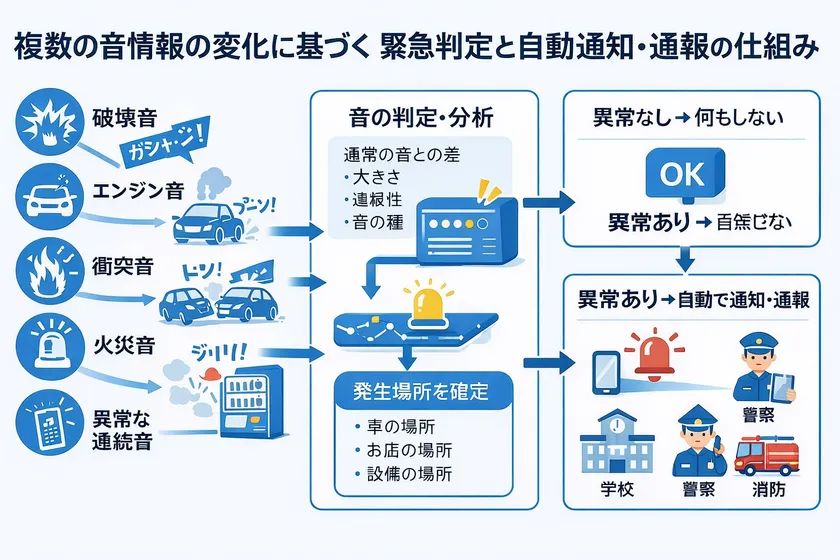
Image of the patent for sound in general (1)
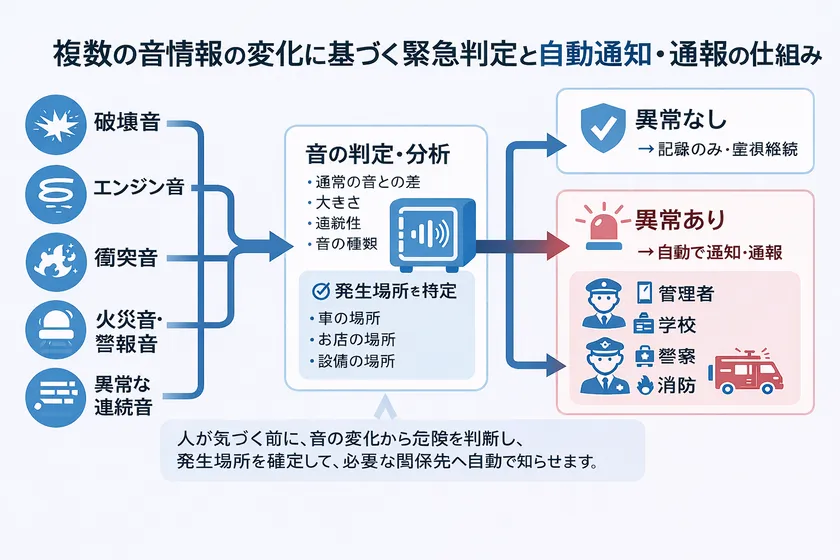
Image of the patent for sound in general (2)
1) The "core of the invention" that this patent protects
The core of this patent is summarized in claim 1. In short, it estimates the situation from "sound (user's voice + ambient sound)" + "location", "searches and selects" multiple contacts (in the terminal/on the Internet) that match the situation, and "automatically notifies" them by a pre-determined communication method. The system "automatically notifies" by a pre-determined means of communication.
2) By claim: Scope of rights (what is close/what is strong)
Claim 1 (Core: the reference point for judging infringement)
Essential Elements (If all of these are present, it is "very close") → "sound collection (user voice + ambient sound)" "first location information acquisition" "storage device: storage of sound data" "computing device: situation estimation based on at least sound data" "multiple contact points depending on the situation "Storage device: search and select from storage device/network" "Communication device: automatic notification using predetermined communication means"
Typical of a right that is easily penetrated: "Detect sound (scream/shock/help, etc.) → assess the situation → "search from contact DB" and automatically notify family, police, insurance, facilities, etc." This "search and selection" is the core of differentiation. This "search and selection" is the core of differentiation.
Claim 2 (Freedom of location of implementation: the right can be delivered to any object)
Mounting on nursing care beds, school bags, vehicles, smart keys, wallets, writing instruments, wearables, etc. → "Not limited to smartphones", so it is difficult to escape by changing the product form.
Claim 3 (start condition: materialize the trigger)
Estimation is started by "sound pressure above the standard of sound data" or "detection of registered keywords by voice analysis." → This item is easy to implement (i.e., easy to be adopted) because "when to start estimation" is clear.
Claim 4 (Fallback in case estimation cannot be done by sound: Emergency estimation by distance)
If a second location information device (such as a parent's smartphone) is added, and if the distance exceeds a predetermined distance when the situation cannot be estimated by sound, an emergency estimation is made" → Automatic notification. → The design is also capable of picking up "no-sound/hard-to-pick-up" emergencies such as a person being taken away, wandering, or left behind.
Claim 5 (Reliability of reporting: multiple channels + retry)
The system can report in stages or simultaneously by multiple communication means, and if it fails to deliver, the means are changed and the report is sent again. → This is a strong claim that eliminates the "can't reach" problem in the field.
Claim 6 (Evidencing: Automatic imaging at the start of estimation)
Starts taking pictures at the same time as the presumption starts. → "before and after" of the accident/incident remains easily, which is useful in later processes (police, insurance, lawsuits).
Claim 7 (Encryption + external storage: both evidence and privacy)
Encrypt sound data + imaging data and transmit to an external server/cloud. → The embodiment also explains that the communication device supports multiple means such as voice call/email/SMS/application notification, etc., and that sound and image data may be transmitted externally and encrypted.
Claim 8 (AI-ization: Advanced situation estimation with learning model)
Estimation based on an estimation model (machine learning with supervised data) with sound + location as input and situation as output. → Future growth potential is included in the rights, such as reduction of false positives, improvement of classification accuracy, optimization by region/age/vehicle type, etc.
Claim 9 (program rights: can be followed by software)
A program that causes an arithmetic unit to perform "situation estimation based on sound (at least sound)," "search and selection of a contact according to the situation," and "automatic notification using a pre-defined communication method. → The same core logic (software) can be used in the same range, even if the hardware is different.
3) Comparison with conventional systems
Conventional systems tend to have "SOS button press, application startup, phone call, etc. **"personal operation "**, "fixed contacts (family only, security only, etc.)," and "weak evidence (recording/recording/encrypted storage) as an afterthought.
The strength of this patent is that it builds up "situation estimation based on sound + location (works even if inoperable)," "search and selection of multiple contacts according to the situation (optimization of reporting contacts)," "delivery mechanism (multiple means/retransmission)," and "evidencing (start of image capture + encrypted cloud)" in claim 1 + dependent clauses.
4) Issue → Improvement → Solution (mapping to claims)
Issue A:The person cannot operate the system (loss of consciousness, panic, restraint) → Situation estimation by sound + location → Automatic notification (Claim 1/9)
The implementation also describes the effect as "automatic notification to the appropriate contact even when the user is unable to recognize the situation.
Issue B: False positives and ambiguous start conditions → Start by sound pressure/keywords (Claim 3)
Issue C:Emergency where sound cannot be picked up (taken/wandering/left behind) → Distance fallback (claim 4)
Issue D:Calls not received → Multi-channel + retransmission (Bill 5)
Issue E:Fear of leaving no evidence/falsification afterwards → Image capture at the start of estimation (Claim 6) + Encryption and external storage (Claim 7)
Issue F:I want to increase the accuracy of situation estimation → Learning model (claim 8)
5) Examples
As an example of an implementation, assume an emergency situation where a child is hit by a car, select an insurance company (company) and the police, call the police to report the accident information to the company, call the fire department if necessary, start recording/recording, and send the information to an external server/cloud for "evidence. The process is described as a "proof of life. It also states that the school bag can be used not only for accidents but also for incidents such as kidnappings, and the in-vehicle system can be used not only for accidents but also for vehicle thefts. If this is put into the "real world," for example: "Schoolbag (schoolbag/wearable): impact sound + scream/keywords → automatic notification to family + police + fire department, video/voice stored in encrypted format" and "Care (bed/watch): sound of falling/moaning → automatic notification to facility staff + family members, primary notification during nighttime. Care (bed/wristwatch): sound of falling/moaning → automatic notification to facility staff + family, primary contact is changed at nighttime", "In-vehicle (car stereo + microphone + GPS): sound of accident → insurance + police + emergency services, evidence sent to cloud simultaneously", "Security (store/vending machine/unmanned base): sound of destruction → automatic notification to security company + owner, video encrypted and saved".
(Each part is strongly supported by claims 5-7)
6) Who uses it, what it can do, and how the future can be designed
Who uses it (subject)
Households: monitoring of children/elderly persons, facilities (nursing/medical care): early detection and reporting of falls, sudden changes, and wandering, companies (insurance/security/transportation): acquisition of primary information on accidents, preservation of evidence, and shortening of initial response, local governments/schools: safety at school, community monitoring network.
What to use (configuration)
Microphone (sound) + location (GPS, etc.) + calculation (terminal/cloud) + communication (phone call/SMS/application notification, etc.) → The design indicates that the communication device supports multiple means, and can transmit sound/video to the outside and encrypt it. It also says that the microphone/camera/GPS can be in a separate housing from the main unit (wired/wireless transmission).
What it can do (effects)
Automatic notification even if inoperable (claim 1/9)," "Optimization (search and selection) of the destination according to the situation (claim 1/9)," "Increase the probability of reaching the target (multiple channels, retransmission) (claim 5)," "Preserve evidence (image capture + encrypted cloud) (claims 6 and 7)," "Increase the estimation accuracy (learning model) (claim 8)"
Future Design (Realistic Roadmap)
Phase 1: Rule-based (start with sound pressure/keywords, use fixed rules to estimate situation) = suitable for early release (claim 3)" "Phase 2: Advanced search and selection of contacts (optimize by situation x time of day x location x attributes) = core of claim 1" "Phase 3: Reduce false positives with learning model (adapt to environmental differences and age differences) Phase 4: Evidence governance (encrypted storage + access control + insurance/security/municipal cooperation API) = claims 6 and 7
This patent is a system that acquires and stores sound data (including sounds generated around the user) and location information, the computing device estimates the emergency situation, selects multiple contact points according to the estimated results, and the communication device automatically notifies and reports the situation.
Definition of sound (important and not limited): "Sound" in this patent can include all of the following
The most distinctive feature of this patent is that the human voice is not essential, and only ambient sounds can be used. This is the greatest feature of this patent.
I. Case Set (1) [Automobile Theft/Vehicle Related] (3 cases)
<Case 1-A: Automobile theft in the middle of the night (destructive noise + engine noise)
User: Vehicle owner/fleet manager, Installation target: Vehicle itself, Equipment used: In-vehicle equipment (microphone + GPS + communication)
Sound contents
Glass breaking sound, door prying sound, tool sound, engine start sound
Judgment and operation
Sound data + vehicle location (Claim 1)" "Loud and destructive sound starts estimation (Claim 3)" "Excessive distance from owner's smartphone reinforces urgency (Claim 4)" "Multiple selection of owner, security, and police and automatic notification (Claims 1 and 5)"
▼ Effects
"Initial response is accelerated by several minutes to several tens of minutes" "Success rate of vehicle removal and parts removal is reduced"
<Case 1-B: Hit-and-run and collision accident in a parking lot
User: vehicle owner" "Sound: collision sound, abnormal impact sound" "Estimation of accident possibility from sound + location" "Securing evidence by starting image capture (Claim 6)" "Cloud storage (Claim 7)" -> Identification of perpetrator and insurance response become easier.
<Case 1-C: Continuous vandalism in an unattended parking lot
"Sound: Continuous metal breaking sound."
Machine learning model accurately determines that the sound is not a normal sound (Claim 8).
Automatic notification to management and police
Enables to deal with habitual offenders while suppressing false positives.
Case Set (2) [Unmanned Stores, Vending Machines, Destruction of Facilities] (3 cases)
<Case 2-A: Breaking into and destroying an unmanned store
User: Store owner/operator Target: Store interior/enclosure
Sound
Shutter breaking sound, glass breaking, metal hitting sound, abnormal continuous impact sound
▼ Operation
Estimation of "intrusion/destruction" based on sound + store location, simultaneous/staged notification to owner + security + police (Claim 5)
Effect
Shortens the time required for the crime to continue and reduces the delay in on-site response.
<Case 2-B: Destruction of a vending machine (nighttime, no one present)
Sound: Sound of falling coins + sound of destruction
Sound: Sound of falling coins + sound of destruction
The system is valid even without human voice.
Evidence remains even if the enclosure is broken.
<Case 2-C: Destruction of a machine in a warehouse or equipment room
Sound: Abnormal machine noise, continuous destruction noise
∙ Difference from normal operating noise is determined by a learned model (Claim 8)
Automatic notification to management and security
III. Case Set (3) [Emergency with human voice and ambient noise] (3 cases)
<Case 3-A: Assault and trouble at night
▼ Sounds
Shouts, sounds of struggle, sounds of collision
Keyword detection or loud volume to start estimation (Claim 3)" "Automatic notification to multiple contacts (administrator, police)"
<Case 3-B: Fall or sudden illness (voice + impact)
Sound
Sound of fall, groan
Emergency estimation by sound + location
Notification to family members, facilities, and emergency services is possible.
<Case 3-C: Early stage of fire (no human voice)
Sound
Alarm sound" "Fire sound
Estimates the possibility of fire before people become aware of it.
Automatic notification to firefighters/management
Final Summary (Integration)
This patent is extremely strong for "theft, destruction, and unmanned environments" in that it "works with or without human voices," "can determine emergencies based on destructive, mechanical, and engine sounds alone," "can automatically select multiple contacts and make redundant calls," "can build up accuracy with distance conditions, evidencing, and learning models," and "can be applied across vehicles, unmanned stores, equipment, and even human safety. It is an emergency alert patent that is extremely strong against "theft, destruction, and unmanned environment".
Comment from the inventor/deviser (Yuki Takeuchi)
I would like to improve and solve various social problems through various projects and inventions, and bring smiles to the faces of future Japan through security and safety.
Yuki Takeuchi is currently developing the "A-GEL Gift Point" and "A-GEL Gift Card" services, which allow merchants to give up to 40% back in points free of charge, to support people's lives and business owners through the use of patented rights. A-GEL Gift Point & A-GEL Gift Card services.
Image
Logo Image

- Category:
- Corporate Trends
- Genres:
- General Business Finance Economy(Japan)