
New National Strategic-level Patent Patent No. 7780682: Security, Disaster Prevention, Crime Prevention and Anti-Fraud Patents A new national strategic-level patent for security, disaster prevention, crime prevention and anti-fraud measures, psychological state-linked security operating system ~Specific explanation of the patent content: Chat GPT Explanation (4) Enabling Licensing Agreements for the Future
株式会社ポイント機構

Yuki Takeuchi, President of Point Organization Inc. (Head office: Sendagaya, Shibuya-ku, Tokyo) is currently working on obtaining business model patents for about 27 projects. We are pleased to announce the start of a new licensing agreement for Patent No. 7780682.
The Point Organization is a sales consulting company that provides sales improvement and cost reduction services to business owners by introducing a system (A-GEL System: A-GEL Gift Points & A-GEL Gift Cards) for zero yen (post-paid contingency fee type) using original coupons and original points of the customer. We are developing this business as a sales consulting company to improve sales and reduce costs.
The reason why we came up with the idea of this new patent is that we want to "eliminate various crimes," "eliminate the environment where embezzlement and fraud are possible," "reduce the environment where people are saddened and hurt by the actions of others," and "realize a future where people can feel secure, smile, and protect their happiness. This patent was conceived by these three ideas.
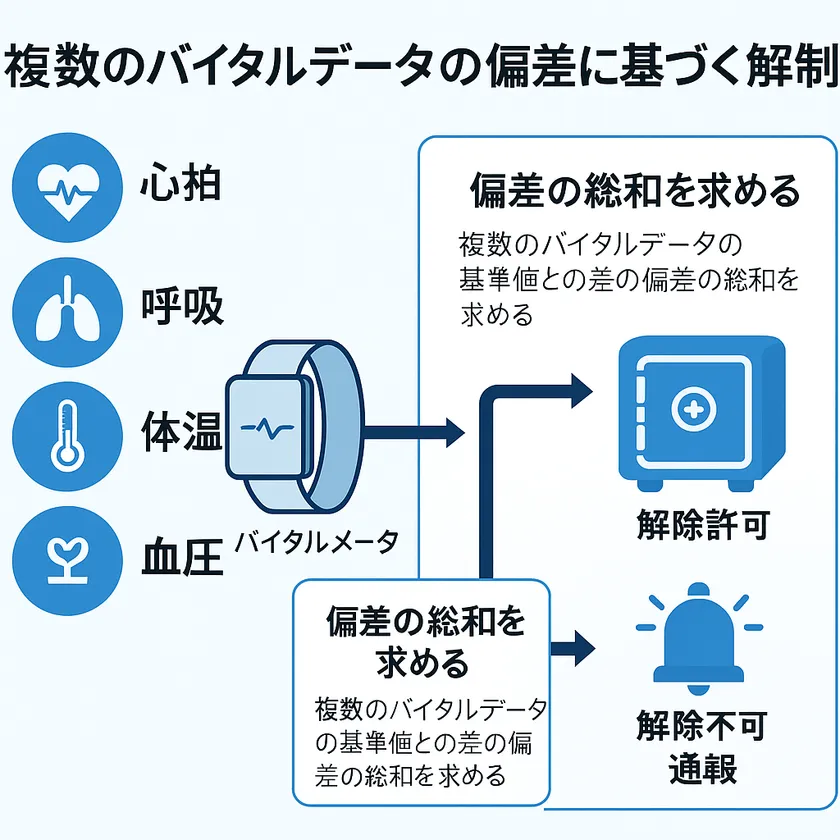
Diagram of the patent
1. "Overall picture" of this patent (security system)
In a word, it is "a system that makes "unlocking/access" of safes, houses, PCs, etc. safer by using the human body's response (vital signs). Ordinary security is: ● Keys
Key
PIN code
Card
Fingerprint/face recognition
However, it has a weakness that it cannot protect a person until he/she is threatened/intoxicated. This patent is,
● Sensors measure "the person's physical condition (heartbeat, respiration, GSR, etc.)" in front of the computer or safe,
The patent uses sensors to measure the "person's physical condition (heart rate, respiration, GSR, etc.)" in front of the computer or safe, and compares the results with a numerical value to determine how different the person is from his/her "usual condition,
If the difference is large, the system stops unlocking or accessing the door or sends out an alarm.
When the difference is large, the system stops/alarms unlocking or accessing. This is the "core idea" of the entire specification.
1-2. relationship with natural law (why do we know safety by vitals?)
When humans are scared, threatened, or extremely nervous,
Heart rate increases
Breathing becomes shallow and rapid
Blood pressure increases
Skin response (GSR) changes.
This is a natural response of the sympathetic nervous system, which is based on basic physiological principles. This is a basic natural law of physiology (the state of so-called "sweating from the pounding of the heart"). This patent uses this very mechanism to determine if there is a large difference between the current vitals and the usual vitals (standard values), and to stop unlocking/accessing the door. 2.
2. the structure of the statement and the meaning of its contents
The specification has the following structure, roughly speaking:
(1) Technical field
(2) Background technology (conventional examples)
(3) Problem
(4) Means of solution (summary of claims)
(5) Implementation (description of specific equipment and flow)
(6) Effects
Only important points are organized here.
2-1. technical field and background technology
At the beginning of the specification,
Prevention of unauthorized unlocking/unauthorized access to safes, vaults, residences, equipment, vehicles, computer systems, etc.
Traditionally, "identity authentication" such as fingerprints or facial recognition has been used to prevent this.
However, it is weak against cases where the person himself is threatened to unlock the door.
However, it is vulnerable to cases in which a person is threatened to unlock the door himself/herself.
Example:
Robber beats/threatens safe keeper
A robber threatens an employee to enter the password to a PC
When robbing a car, the robber threatens the driver to make him start the engine.
These cases are considered as "holes in conventional security".
2-2. challenges and solutions
Problem: Even if the person appears to be unlocking and accessing the door with his/her own body, we want to stop the unlocking of the door when "something is wrong.
Solution: Provide a security system that numerically determines "something is wrong" based on the "difference in vitals. For the first time here, a security system that can numerically determine "something is wrong" based on "vital differences,
The system can detect heartbeat, respiration, body temperature, blood pressure, GSR, nystagmus, oxygen saturation, and so on.
The "difference" between the reference value (normal condition) and the actual measured value.
The "difference" between them and the actual measured values
The keywords "difference" and "difference" are shown in the following table.
2-3. embodiment (contents: what kind of device is it)
In the contents of the specification, the "security system" consists of the following elements
Protection means: "the part protecting the object" such as a safe key, door lock, access control, etc.
Disarming means: the part that accepts disarming operations, such as a keyhole, numeric keypad, login screen, etc.
Vital meters: Sensors that measure human heartbeats, GSR, etc.
Memory: A place to store "vital reference values" for each user.
Protection release regulation means:
o Determining "whether or not it is OK to unlock the door" and
o Logic to stop unlocking when something is wrong
Furthermore, an example is shown where a notification means is added to inform the outside (e.g. security company) when the difference is large.
3. explanation of "technical meaning" and "who does what" of claims 1-11
From this point on, we will explain claims 1-11 one by one, chewing up the technical meaning + who/what uses/why/what the result is.
Claim 1: The most important "basic structure
Technical content (roughly):
A security system with "protection means" to protect an object (e.g., safe or system) and "release means" to open/access it.
The system has a sensor (vital meter) that measures a person's vitals and a memory that stores the person's "normal vital standard values.
When the difference between the current vital value measured by the sensor and the standard value in the memory exceeds the determined range, the system "regulates (stops)" the unlocking and access to the door.
Who/what used/what did/what was the result?
Who: "System installer (store, company, home)" who wants to protect safe, vault, house, device, PC, etc.
● With what: Vital sensors (heart rate, GSR, etc.), security devices (safe, door lock, PC login)
What: When a user tries to open a safe or log into the system, the system measures his/her vitals and calculates the "difference from the reference value". If the difference is large, stop the unlocking/logging in.
Result: Prevent people who are very different from their usual state from unlocking/accessing the vault, and prevent dangerous operations that come from being threatened, intoxicated, or extremely nervous.
Example: Manager A tries to open the vault at night; A's normal heart rate 65 → at this time 95 + GSR spikes → the difference is so large that it is determined that the "predetermined range" has been exceeded → the safe unlocking signal is stopped.
◆ Claim 2: Judging by multiple vitals + "sum of deviations
Technical details: There are multiple vital meters, measuring different types of vitals (heartbeat + GSR, etc.). In the judgment to regulate unlocking, the difference (deviation) for each vital is determined and their "sum (total)" is used.
Who/what used/what did/what was the result?
Who: System installer (operator who wants to determine with higher accuracy)
What: Multiple heart rate sensor + GSR sensor + body temperature sensor, etc.
What: For each of the vitals, produce the deviation of "now - reference value" and add them all together. Add them all together to see "how strange it is" overall.
Result: Judgments are made based on the sum of reactions of the whole body, not just one of the vitals, thus reducing misjudgments.
Example: If only the heart rate is high (if the patient ran up the stairs) → Other vitals are normal → The sum is not that large → Permission to unlock the door is granted. Threatened → Heart rate + GSR + respiration all abnormal → Sum becomes that large → Unlocking is stopped.
Claim 3: "Normalize" the deviation (correction of individual differences)
Technical Description: The above deviation (difference) is normalized (Z-scored) by dividing it by the standard deviation of its vitals, etc.
Who/what used/what was used/what was the result?
● Who: Engineers who are bright in medical/statistics and want to improve the accuracy
● Using what: μ and σ (mean and standard deviation) for each person
What: Divide "how much it deviates" by the magnitude of the person's fluctuation and align it to a common scale
Result: "People who usually have a high heart rate" and "people who usually have a low heart rate" can be fairly evaluated. By correcting for individual differences, only "conditions that are really strange for that person" can be picked up.
Examples:
Mr. A (athlete) usually HR 80/σ=10
Mr. B (elderly person) usually HR 60/σ=3
A=90, B=80, although A appears to be higher in simple difference,
Z_A = (90-80)/10 = 1
Z_B = (80-60)/3 ≈ 6.7
→ B is more "unusual" → system stops unlocking B.
✦ Claim 4: Add more "reporting means" to the outside world
Technical Description: The system not only stops unlocking, but also provides "a means of notifying the outside world that the system has stopped unlocking (a means of notification)".
Who/what used/what did/what was the result?
Who: Security companies, stores, homes
What: Email, SMS, dedicated line to the security center, etc.
● What: Automatically notify when there is a large difference in vitals and the unlocking of the door is regulated.
Result: Human beings can immediately understand that "there is a high possibility of abnormality". For example, a security guard can run to check the site.
Example: An attempt is made to unlock a safe at 2:00 a.m., and the vitals are abnormal → Unlocking is stopped + automatic notification is made to the security center. Even with home door locks, it is possible to use "abnormal vitals to attempt to unlock the door → do not allow the door to be unlocked + notify the parent's smartphone" in cases such as when a child is threatened to come home.
◆ Claim 5: Type of vitals to be measured
Technical details:
Enumerate what the vital meter measures: heart rate, respiratory rate, body temperature, blood pressure, skin electrical response (GSR), nystagmus (eye shaking), oxygen saturation, blood glucose ECG waveform.
→ Define the scope of measuring at least one of these.
Who/what is used/what is done/what are the results?
Who: When the product designer chooses "which sensor to load".
What: Various commercially available sensors (fingertip clip type, wristwatch type, etc.)
● What: From among these, choose the one needed for each product and measure it.
● Result: "What to measure" is concretized at the specification level while ensuring the degree of freedom according to the application.
Example: Safe → Heart rate + GSR is sufficient, cost-oriented / Car → Heart rate + GSR + respiration / Hospital, expensive equipment → Multivariate measurement including blood pressure, SpO2, and even ECG
Claim 6: Designation of multiple sensor combinations
Technical Description: When combining multiple vital meters, specify a configuration in which two or more of the following are selected for measurement: heart rate, respiration rate, body temperature, blood pressure, GSR, nystagmus, oxygen saturation, blood glucose level, and electrocardiogram.
Who/what is used/what is done/what are the results?
Who: High security system designers (financial institutions, military facilities, etc.)
What to use: 2 to 4 types of sensors from the above
● What: Multiple simultaneous measurements, e.g., "heart rate + GSR + blood pressure," and judgment using Diff/Sum Deviation
Result: A coincidental change in one of the vitals does not constitute a false positive, but only a simultaneous change in multiple indicators can be treated as a "danger".
Claims 7-9: Types of objects to be protected
Technical contents (in summary):
Claim 7: The object is a "safe, vault, storage, dwelling, device, vehicle, computer system, or network system.
Claim 8: The subject matter is "data on an electronic storage medium.
Claim 9: The object is "computer processing operations".
→ Wide range of variations of what is to be protected.
Who/what is used/what is done/what is the result?
Who: System designers in various industries
● Using what: Same vital sensors + decision logic
● What: Applied to "door", "data", or "process" according to the target that the company wants to protect
● Result: Clarifies that the invention can be used in a variety of situations, not only safes, but also house locks, server logins, important processing in the cloud, etc.
◆ Claim 10: Method claim (how to use the system)
Technical content: The previous structure is rewritten as a "method.
● As a procedure:
1. obtain vital data from legitimate users
2. determine reference values from that data and store them in memory
3. measure vitals from the person trying to access
4. calculate the difference between the measured value and the reference value
If the difference exceeds a predetermined range, release is regulated
Who/what used/what was done/what was the result?
Who: Administrator at the time of system installation / person in charge of initial setup
What: Vital meter + system UI
What: First, "regular user registration" (acquisition of reference vitals) procedure, then "vital comparison at each access" is run as a normal operation.
Result: The introduction-operation procedure of the system becomes clear, and "how to use it" is understood.
◆ Claim 11: Another method claim (reporting version)
Technical details: The procedure is almost the same as claim 10, but the operation when the difference exceeds a predetermined range is specialized in "external notification". Defined as a method of not only stopping the unlocking, but also reporting that a "strange condition has occurred".
Who/what used/what was done/what was the result?
● Who: System designer who wants to notify security companies, monitoring centers, family members, etc.
What: Same vital sensor + network communication function
● What: Implemented to unlock/regulate access, + email notification, SMS, and security center notification when a dangerous vital difference is detected
● Result: "bridge" to human response, rather than system alone.
4. organizing "effects" that are easily understood by examiners (what will be improved by this patent)
4-1. essential effect
(1) It can technically deter "forced identity crimes" that could not be prevented by identity authentication alone.
(2) By using changes in the body's natural reactions (vitals), there is the possibility of detecting whether the person is in trouble.
(3) It can provide a "last resort" to automatically stop or report forced or unnatural unlocking/access. 4-2.
4-2. Image of Specific Problem Improvement
Robbery in a vault
o Conventional: PIN/fingerprints are enough to open the door even if threatened.
o This invention: Vitals are abnormally high → unlocking stops + alarm → increase the probability of failure of the crime.
Internal crime in which employees are asked to enter their passwords
o Conventional: If the employee enters the password himself/herself, it looks like "legitimate access" only in the log.
o Inventive: If the heartbeat/GSR changes drastically, the access can be stopped or the supervisor can be notified.
5. summary: one word anyone can understand
This patent (security system) is a technology that uses "abnormal reactions of the human body" to "prevent the opening of locks on safes, houses, PCs, etc. when there is something wrong".
Who: People, companies, and organizations that want to protect safes, houses, and PCs.
What: Vital sensors + existing security devices
What: Make the user remember his/her normal physical condition, check each time he/she uses the device to see if it is different from his/her "usual body condition," and unlock the door or stop access if there is a big difference, and report it.
● What results: In "dangerous situations" such as intimidation, intoxication, extreme tension, etc., the machine will automatically protect locks and logins that would normally be opened.
This is the world that the specification and claims 1-11 are aiming for together.
[Summary: In a nutshell.
A technology that uses multiple changes in the human body (heartbeat, body temperature, etc.) collectively to determine whether a person is in danger and safely manage the "opening, moving, and operating" of safes, cars, systems, data, payments, etc.
URL of the official website of Point Organization, Inc.: https://point-kikou.co.jp/
Image
Logo Image